
Bangle Bracelet
Showing all 6 results
-

Classic gold bangle – 18 carats
-

Constance open gold-plated bangle bracelet
-

Customizable gold-plated Josephine bangle
-

Heritage gold-plated bangle
-

Heritage silver bangle
-

Heritage yellow gold bangle – 18 carats
Bangle bracelet: the rigid band designed for a child’s wrist
The bangle bracelet stands out for its rigid structure, in an open or closed ring shape, with no moving clasp. This design reduces the risk of losing it from a baby’s or young child’s wrist, unlike an ID bracelet whose clasp can come undone under pressure. The bangle slides on or slightly opens at the gap, then returns to its shape once in place. It’s a popular choice for a birth or christening gift, often paired with a medal or a chain in the same gift box.
Bangle or ID bracelet: two different approaches to a birth gift
The ID bracelet is made of linked chain segments and closes with a lobster clasp or spring ring: it’s easy to adjust but exposes the closure to wear and accidental opening. The bangle, on the other hand, has no such moving part. Its size is fixed at the time of manufacture, which means choosing the right diameter at the time of purchase rather than adjusting it afterward. In return, it lasts through the early months without any risk of a faulty clasp, a feature many godparents value for a baby who wears the piece continuously.
The openable bangle, a variant with controlled opening
Some bangles are designed to open: a thin section of the ring spreads a few millimetres apart to allow the hand to pass through, then closes back without a clasp. Others are fully closed and must therefore be chosen in exactly the right size, with no way to adjust once the wrist grows larger. Before buying, it’s best to check whether the model is openable or closed: this directly affects the margin of error allowed on the diameter.
What bangle diameter for a newborn or young child
A newborn’s wrist measures on average between 33 and 38 mm in internal diameter during the first months, compared to 40 to 45 mm after one year and up to 50 mm around 3-4 years old. A bangle that’s too tight leaves marks on the skin and restricts circulation; too loose, and it slips over the hand and gets lost. Here are a few useful guidelines when choosing:
- Birth to 6 months: internal diameter around 33 to 36 mm, favouring an openable model to allow for rapid growth
- 6 months to 2 years: 38 to 42 mm, a period when the wrist thickens quickly
- 2 to 5 years: 44 to 50 mm, a closed bangle becomes more suitable as growth slows down
These ranges are only a guide: a slender wrist at 18 months can match the measurement of a 6-month-old baby. Measuring the wrist circumference with a flexible tape before buying avoids trial and error.
18-carat gold, 9-carat gold or 925 silver: which material for a christening bangle
18-carat gold (750/1000) keeps its shine without special care and holds up well to prolonged contact with a baby’s skin, including moisture and saliva. 9-carat gold (375/1000), more common in some European markets, contains less precious metal and costs less, at the price of a slightly paler tone. Solid 925 silver remains a solid option for a first piece of jewelry, provided you accept more regular upkeep: it tarnishes on contact with air and regains its shine with a simple soft cloth, without any abrasive product.
Vermeil, a silver base coated in gold
Vermeil combines a 925 silver structure with a layer of gold applied on the surface. It offers the golden look of gold at a lower weight and cost than a solid bangle. The gold layer wears away over time in areas of friction, making it more suitable for jewelry worn occasionally, better reserved for earrings or a small ring rather than a bangle worn continuously.
Engraving a bangle bracelet: first name and date of birth
A bangle is most often engraved on its outer face, at the widest point of the ring. The available space remains limited: a short first name of 4 to 6 letters fits without difficulty, while a full date in day-month-year format already takes up a good part of the surface. Beyond that, the engraving becomes hard to read with the naked eye. Some parents prefer a single initial paired with the date, to keep a clean engraving even on a thin bangle. This engraving practice is also found on a cross or an ID bracelet, with the same legibility constraints linked to the thickness of the metal.
A bangle paired with other pieces for a christening
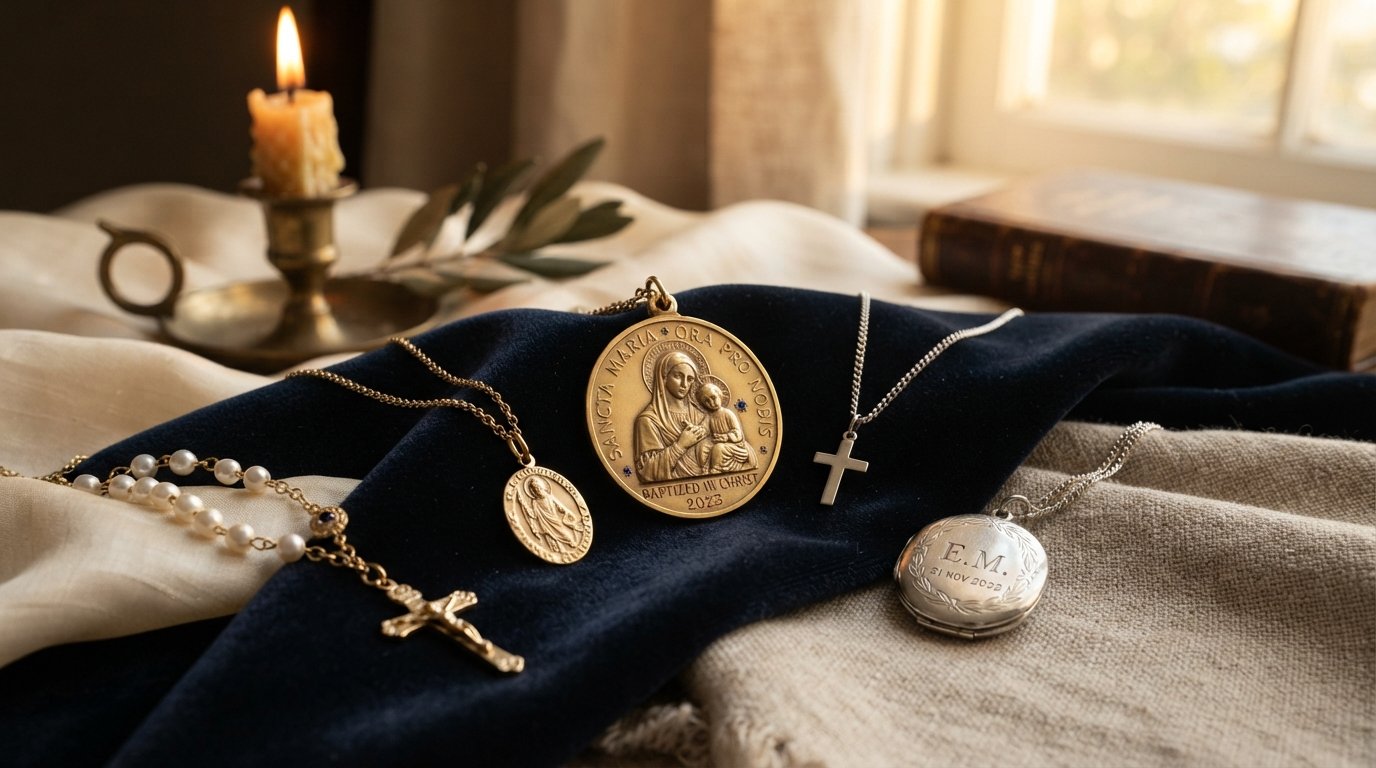
The bangle bracelet is rarely worn alone for a christening. It frequently complements a medal worn as a pendant or a signet ring given for a later milestone, such as a communion or birthday. Choosing the same material and the same finish for all the pieces, polished 18-carat gold with polished 18-carat gold, for example, avoids visible shade differences when the pieces of jewelry are worn side by side.