Gold Jewelry
Purity determines everything in a gold jewel. An 18ct piece contains 750 parts per thousand of pure gold, the most common standard in French jewelry for a piece meant to last. 9ct gold, at 375 parts per thousand, costs less for the same weight and suits lighter pieces. This page brings together medallion bracelets, pendants, earrings, bangles and rosary bracelets in these two purities.
The choice starts with how it will be worn: a jewel worn every day doesn’t face the same demands as a piece taken out for a special occasion. A 9ct medallion holds up just as well as an 18ct one against everyday knocks, but its shine is slightly less intense, since pure gold gives the metal its deep colour.
Gold medallion bracelet: the medallion moved to the wrist
The gold medallion bracelet takes the idea of the neck medallion and moves it to the wrist: an engravable disc on the back, mounted on a fine chain. On these bracelets, the medallion is most often between 10 and 14 mm in diameter, smaller than a classic neck medallion so as not to weigh down the wrist.
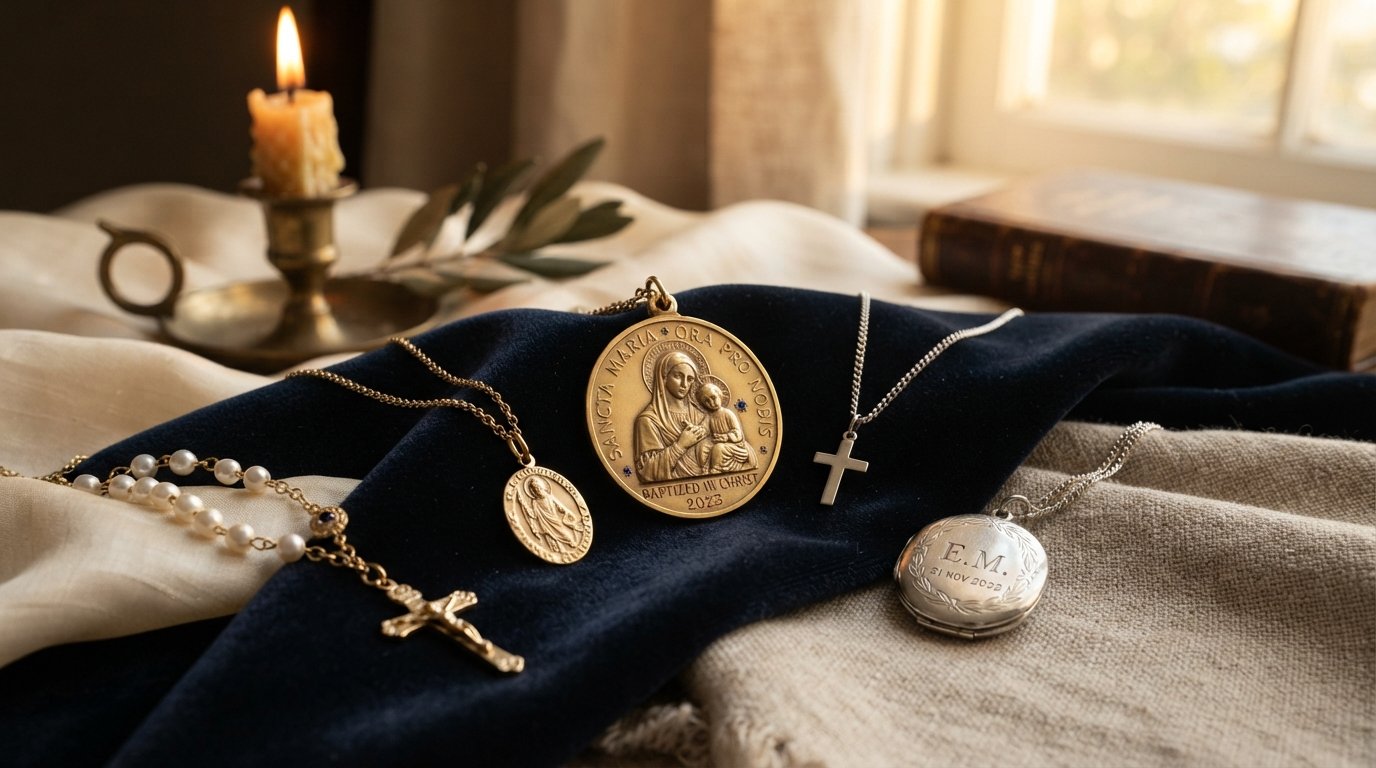
The engraving on the back stays short: a first name, a date in day/month/year format, sometimes initials. The surface of a disc this size limits legible engraving to around fifteen characters visible to the naked eye. This format is chosen for a birth, a communion or a birthday, when the gift needs to stay personal without a long text.
Gold jewelry set with diamonds: what the stone changes
A gold pendant or earring set with diamonds combines two materials that catch the light differently: gold reflects a warm, continuous light, while diamond breaks it into sparkling flashes. On everyday fine jewelry pieces, the set stones are most often small round diamonds, chosen for their consistency more than their size.
This type of jewel shifts into a different category compared to a medallion or a bangle: it’s worn for a specific occasion, a wedding anniversary, a birth, more rarely on a daily basis. Setting stones requires a sturdier mount, which explains why it’s found mainly on pendants and earrings rather than on fine bracelets.
Gold earrings and cultured pearls: stud or drop
Gold earrings fall into two distinct families. The stud, fixed to the lobe, suits permanent wear, including in a professional setting. The drop, more mobile, moves with the head and catches more light: it’s better suited to occasions where the movement of the jewel matters.
Models set with cultured pearls add a softer, more matte tone next to the warmth of the gold. A freshwater cultured pearl, the most common on this type of earring, generally measures between 4 and 8 mm: below that, the effect gets lost against the lobe; above it, the earring becomes too heavy for everyday wear.
Mini treasures: small gold jewelry for a communion or a birth
Mini treasures are very small gold jewels: crosses, miniature medallions, discreet pendants, often mounted on a fine chain or cord. For a child, the chain is usually chosen between 40 and 45 cm, a length that leaves several years of margin before needing to be changed.
The small format isn’t just a matter of budget: a pendant just a few millimetres wide stays discreet under a school or communion collar, while a larger piece draws the eye and catches more easily on clothing. It’s as much a practical choice as a size choice.
Classic solid gold bangle: a rigid bracelet that lasts
The solid gold bangle stands apart from chain-link bracelets through its rigid structure, either a single piece or opening on a hinge. This construction limits weak points: no link that can come open, no clasp that wears out over the years. This is what explains the longevity of this type of bracelet, often worn for decades without repair.
A bangle can be worn alone, as a single statement piece, or stacked with other fine bracelets to play with thickness. Its weight mainly depends on its inner diameter and its cross-section: the thicker the section, the more presence the bracelet gains on the wrist, and the more it weighs.
Gold rosary bracelet: counting a decade on the wrist
The rosary bracelet takes the idea of a rosary reduced to a decade of beads, worn on the wrist rather than in the hand. The Miraculous Medal, which often accompanies this type of bracelet, depicts the Virgin as she is said to have appeared to Catherine Labouré in Paris in 1830; the medal itself began to be struck two years later, in 1832.
Worn daily, this bracelet works as a discreet jewel more than a visible object of devotion. It’s chosen for a communion, a confirmation, or as a christening gift, when looking for a piece that keeps its meaning as the child grows.
Frequently asked questions about gold jewelry
What’s the difference between 18ct and 9ct gold?
18ct gold contains 750 parts per thousand of pure gold, 9ct gold 375 parts per thousand. The former has a deeper colour and a higher price for the same weight; the latter suits lighter jewelry or a tighter budget, without losing durability for everyday use.
Which gold jewel should I choose for a communion?
A mini treasure, an engraved medallion bracelet or a rosary bracelet work best: these are formats designed for a child or teenager, discreet and easy to wear without getting in the way day to day.
Can a gold jewel be engraved?
Engraving is done on the back of medallion bracelets and some pendants. The available space stays limited to a few characters: a first name, a date, sometimes initials, rarely a full word.
What chain length should I choose for a child?
Between 40 and 45 cm for most children. This range leaves several years of growing room before the chain needs to be changed.
Is a gold bangle worn alone or with other bracelets?
Both work. Worn alone, the solid bangle draws attention through its simplicity. Stacked with finer bracelets, it adds volume and a contrast of textures on the wrist.
What is the difference between 9K, 14K and 18K gold for a baptism medal?
The number refers to gold purity. 9K contains 37.5% gold and resists scratches best, which suits an active child. 14K (58.5%) balances durability and warmth of colour. 18K (75%) gives the richest yellow but marks more easily. For a gold baptism medal worn daily, 14K is the usual compromise.
Which chain length should I choose for a baby or a child?
For newborns and infants up to 12 months, a 14 in (35 cm) chain sits comfortably without slipping over the head. Ages 2 to 6 usually need 16 in (40 cm), and 7 to 12 years 18 in (45 cm). Many parents buy the medal alone and add a longer chain for a christening later. Check the clasp closes flat against the skin.
How do I clean a gold christening medal without damaging the engraving?
Soak the piece for ten minutes in warm water with a drop of mild washing-up liquid, then brush the engraved lines gently with a soft toothbrush. Rinse and dry with a lint-free cloth. Avoid bleach, ultrasonic cleaners and abrasive pastes, which blur engraved gold jewellery detail and attack any enamel or pearl setting.
Can the medal be engraved, and what is usually written on the back?
Most solid gold pieces in this collection have a flat reverse suitable for engraving. The standard choice is the child’s first name with the baptism date, sometimes with the godparents’ initials. Allow two to three lines of about twelve characters each on an 15 to 18 mm medal. Engraving is normally done before delivery and cannot be undone.
Showing 1–54 of 64 results
-

18 karat gold pearl pendant – 18 carats
£107.99 -

Amethyst “Éclat de Vie” pendant – 18 carats
£161.99 -

Anna pearl earrings – 9 carats
£251.99 -

Aquamarine “Éclat de Vie” pendant – 18 carats
£167.99 -

Beaded fleur-de-lis earrings – 18 carats
£239.99 -

Botticelli Madonna gold medal bracelet – 18 carats
£593.99 -

Clover earrings – 18 carats
£215.99 -

Customizable disc pendant – 18 carats
£497.99 -

Customizable gold token – 18 carats
£497.99🛒 This product has multiple variants. The options may be chosen on the product page -

Diamond earrings – 18 carats
£389.99 -

Diamond medal bracelet – 18 carats
£545.99 -

Diamond solitaire necklace – 18 carats
£895.99 -

Diamond solitaire pendant – 18 carats
£335.99 -

Dove bracelet on blue cord – 18 carats
£353.99 -

Dove bracelet on pink cord – 18 carats
£353.99 -

Edelweiss earrings – 18 carats
£167.99 -

Eugénie earrings – 18 carats
£203.99 -

Family yellow gold bracelet – 18 carats
£1,439.99🛒 This product has multiple variants. The options may be chosen on the product page -

Gold-plated Josephine token only
£77.99 -

Holy Spirit Dove christening medal – 18 carats
£371.99🛒 This product has multiple variants. The options may be chosen on the product page -

Honorine bracelet – 9 carats
£197.99 -

Honorine earrings – 9 carats
£143.99 -

Honorine necklace – 9 carats
£293.99 -

Honorine ring – 9 carats
£203.99🛒 This product has multiple variants. The options may be chosen on the product page -

Large diamond medal pendant – 18 carats
£449.99 -

Large yellow gold pearl earrings – 18 carats
£149.99 -

Latin cross pendant – 18 carats
£143.99 -

Mini circle – 18 carats
£155.99 -

Mini flared cross – 18 carats
£185.99 -

Mini Greek cross – 18 carats
£185.99 -

Mini openwork dove – 18 carats
£155.99 -

Mini openwork heart – 18 carats
£155.99 -

Mini openwork Roman cross – 18 carats
£185.99 -

Mini star – 18 carats
£155.99 -

Mini star cross – 18 carats
£173.99 -

Mini Stella – 18 carats
£155.99 -

Miraculous gold bracelet – 18 carats
£389.99🛒 This product has multiple variants. The options may be chosen on the product page -

Miraculous medal – Virgin of the Poor – 18 carats
£407.99 -

Miraculous medal and cross decade bracelet – 18 carats
£395.99 -

Mother of pearl beaded token
£341.99 -

Mother of pearl Roman cross bracelet on round curb chain – 18 carats
£317.99 -

Mother of pearl Roman cross pendant – 18 carats
£131.99 -

Mother of pearl tree of life – 18 carats
£287.99 -

Open cross decade ring in gold – 18 carats
£305.99 -

Open Miraculous Medal decade ring in gold – 18 carats
£317.99 -

Openwork flying dove christening medal in yellow gold – 18 carats
£419.99 -

Openwork Ictus – 18 carats
£215.99 -

Openwork Tree of Life pendant – 18 carats
£455.99 -

Our Lady of Wisdom portrait medal bracelet – 18 carats
£695.99 -

Oval jaseron chain bracelet – 18 carats
£1,445.99🛒 This product has multiple variants. The options may be chosen on the product page -

Radiant Heart christening medal – 18 carats
£425.99 -

Radiant Virgin and Child gold medal bracelet – 18 carats
£593.99 -

Radiant Virgin and Child medal bracelet – 18 carats
£695.99 -

Roman cross bracelet – 18 carats
£449.99
Purity determines everything in a gold jewel. An 18ct piece contains 750 parts per thousand of pure gold, the most common standard in French jewelry for a piece meant to last. 9ct gold, at 375 parts per thousand, costs less for the same weight and suits lighter pieces. This page brings together medallion bracelets, pendants, earrings, bangles and rosary bracelets in these two purities.
The choice starts with how it will be worn: a jewel worn every day doesn’t face the same demands as a piece taken out for a special occasion. A 9ct medallion holds up just as well as an 18ct one against everyday knocks, but its shine is slightly less intense, since pure gold gives the metal its deep colour.
Gold medallion bracelet: the medallion moved to the wrist
The gold medallion bracelet takes the idea of the neck medallion and moves it to the wrist: an engravable disc on the back, mounted on a fine chain. On these bracelets, the medallion is most often between 10 and 14 mm in diameter, smaller than a classic neck medallion so as not to weigh down the wrist.
The engraving on the back stays short: a first name, a date in day/month/year format, sometimes initials. The surface of a disc this size limits legible engraving to around fifteen characters visible to the naked eye. This format is chosen for a birth, a communion or a birthday, when the gift needs to stay personal without a long text.
Gold jewelry set with diamonds: what the stone changes
A gold pendant or earring set with diamonds combines two materials that catch the light differently: gold reflects a warm, continuous light, while diamond breaks it into sparkling flashes. On everyday fine jewelry pieces, the set stones are most often small round diamonds, chosen for their consistency more than their size.
This type of jewel shifts into a different category compared to a medallion or a bangle: it’s worn for a specific occasion, a wedding anniversary, a birth, more rarely on a daily basis. Setting stones requires a sturdier mount, which explains why it’s found mainly on pendants and earrings rather than on fine bracelets.
Gold earrings and cultured pearls: stud or drop
Gold earrings fall into two distinct families. The stud, fixed to the lobe, suits permanent wear, including in a professional setting. The drop, more mobile, moves with the head and catches more light: it’s better suited to occasions where the movement of the jewel matters.
Models set with cultured pearls add a softer, more matte tone next to the warmth of the gold. A freshwater cultured pearl, the most common on this type of earring, generally measures between 4 and 8 mm: below that, the effect gets lost against the lobe; above it, the earring becomes too heavy for everyday wear.
Mini treasures: small gold jewelry for a communion or a birth
Mini treasures are very small gold jewels: crosses, miniature medallions, discreet pendants, often mounted on a fine chain or cord. For a child, the chain is usually chosen between 40 and 45 cm, a length that leaves several years of margin before needing to be changed.
The small format isn’t just a matter of budget: a pendant just a few millimetres wide stays discreet under a school or communion collar, while a larger piece draws the eye and catches more easily on clothing. It’s as much a practical choice as a size choice.
Classic solid gold bangle: a rigid bracelet that lasts
The solid gold bangle stands apart from chain-link bracelets through its rigid structure, either a single piece or opening on a hinge. This construction limits weak points: no link that can come open, no clasp that wears out over the years. This is what explains the longevity of this type of bracelet, often worn for decades without repair.
A bangle can be worn alone, as a single statement piece, or stacked with other fine bracelets to play with thickness. Its weight mainly depends on its inner diameter and its cross-section: the thicker the section, the more presence the bracelet gains on the wrist, and the more it weighs.
Gold rosary bracelet: counting a decade on the wrist
The rosary bracelet takes the idea of a rosary reduced to a decade of beads, worn on the wrist rather than in the hand. The Miraculous Medal, which often accompanies this type of bracelet, depicts the Virgin as she is said to have appeared to Catherine Labouré in Paris in 1830; the medal itself began to be struck two years later, in 1832.
Worn daily, this bracelet works as a discreet jewel more than a visible object of devotion. It’s chosen for a communion, a confirmation, or as a christening gift, when looking for a piece that keeps its meaning as the child grows.
Frequently asked questions about gold jewelry
What’s the difference between 18ct and 9ct gold?
18ct gold contains 750 parts per thousand of pure gold, 9ct gold 375 parts per thousand. The former has a deeper colour and a higher price for the same weight; the latter suits lighter jewelry or a tighter budget, without losing durability for everyday use.
Which gold jewel should I choose for a communion?
A mini treasure, an engraved medallion bracelet or a rosary bracelet work best: these are formats designed for a child or teenager, discreet and easy to wear without getting in the way day to day.
Can a gold jewel be engraved?
Engraving is done on the back of medallion bracelets and some pendants. The available space stays limited to a few characters: a first name, a date, sometimes initials, rarely a full word.
What chain length should I choose for a child?
Between 40 and 45 cm for most children. This range leaves several years of growing room before the chain needs to be changed.
Is a gold bangle worn alone or with other bracelets?
Both work. Worn alone, the solid bangle draws attention through its simplicity. Stacked with finer bracelets, it adds volume and a contrast of textures on the wrist.
What is the difference between 9K, 14K and 18K gold for a baptism medal?
The number refers to gold purity. 9K contains 37.5% gold and resists scratches best, which suits an active child. 14K (58.5%) balances durability and warmth of colour. 18K (75%) gives the richest yellow but marks more easily. For a gold baptism medal worn daily, 14K is the usual compromise.
Which chain length should I choose for a baby or a child?
For newborns and infants up to 12 months, a 14 in (35 cm) chain sits comfortably without slipping over the head. Ages 2 to 6 usually need 16 in (40 cm), and 7 to 12 years 18 in (45 cm). Many parents buy the medal alone and add a longer chain for a christening later. Check the clasp closes flat against the skin.
How do I clean a gold christening medal without damaging the engraving?
Soak the piece for ten minutes in warm water with a drop of mild washing-up liquid, then brush the engraved lines gently with a soft toothbrush. Rinse and dry with a lint-free cloth. Avoid bleach, ultrasonic cleaners and abrasive pastes, which blur engraved gold jewellery detail and attack any enamel or pearl setting.
Can the medal be engraved, and what is usually written on the back?
Most solid gold pieces in this collection have a flat reverse suitable for engraving. The standard choice is the child’s first name with the baptism date, sometimes with the godparents’ initials. Allow two to three lines of about twelve characters each on an 15 to 18 mm medal. Engraving is normally done before delivery and cannot be undone.
