
Jewelry
Showing 1–36 of 76 results
-

18 karat gold pearl pendant – 18 carats
-

Alma gold-plated bangle bracelet
-

Amethyst “Éclat de Vie” pendant – 18 carats
-

Anna pearl earrings – 9 carats
-

Aquamarine “Éclat de Vie” pendant – 18 carats
-

Beaded chain in silver with yellow gold finish
-

Beaded fleur-de-lis earrings – 18 carats
-

Beaded silver charm
-

Botticelli Madonna gold medal bracelet – 18 carats
-

Botticelli’s Madonna gold medal bracelet – 9 carats
-

Classic gold bangle – 18 carats
-

Clover earrings – 18 carats
-

Constance open gold-plated bangle bracelet
-

Customizable gold token – 18 carats
-

Customizable gold-plated Josephine bangle
-

Diamond medal bracelet – 18 carats
-

Diamond solitaire necklace – 18 carats
-

Dove bracelet on blue cord – 18 carats
-

Dove bracelet on pink cord – 18 carats
-

Edelweiss earrings – 18 carats
-

Eugénie earrings – 18 carats
-

Family yellow gold bracelet – 18 carats
-

Garance gold-plated bangle bracelet
-

Gold-plated intertwined ring
-

Gold-plated Josephine token only
-

Gold-plated rose window pendant
-

Gold-plated sun pendant
-

Heritage gold-plated bangle
-

Heritage silver bangle
-

Heritage yellow gold bangle – 18 carats
-

Holy Star christening medal – 18 carats
-

Honorine bracelet – 9 carats
-

Honorine earrings – 9 carats
-

Honorine necklace – 9 carats
-

Honorine ring – 9 carats
-

Large diamond medal pendant – 18 carats
Rings, bracelets, necklaces and earrings for special occasions
Choosing a jewelry piece for a birth, christening or communion comes down to a few precise criteria: the material, the diameter for a medallion, the chain length, and sometimes the engraved emblem. This category brings together rings, bracelets, necklaces and pendants and earrings, in 18-karat gold, 9-karat gold, solid silver or mother-of-pearl. A chain is also chosen based on its link type: the curb link, with identical oval links, is the easiest to maintain for a child; the twisted rope link catches the light better but bends more easily under strain; the marine link, wider, suits a men’s bracelet.
Which material to choose: 18-karat gold, 9-karat gold, solid silver or mother-of-pearl?
The choice depends first on the intended use, then on budget.
18-karat yellow, white or rose gold (750/1000)
Hallmarked at 750/1000, 18-karat gold resists oxidation and keeps its color over time. It’s the material to choose for a piece worn over several decades: a christening medallion, or a gold chain a child wears every day. 9-karat gold (375/1000) contains less precious metal; more affordable, it’s still sturdy but its tone may shift slightly over the years.
925 solid silver
Solid silver hallmarked at 925/1000 tarnishes on contact with air and perspiration, a normal effect that a suitable cloth easily corrects. It’s a common choice for a child’s first ring or bracelet, since the piece is likely to need resizing in the years that follow. On the finish side, a glossy polish shows micro-scratches over time; a sanded matte finish hides them better day to day; a hammered finish, with its slight relief, camouflages wear marks almost entirely.
Mother-of-pearl
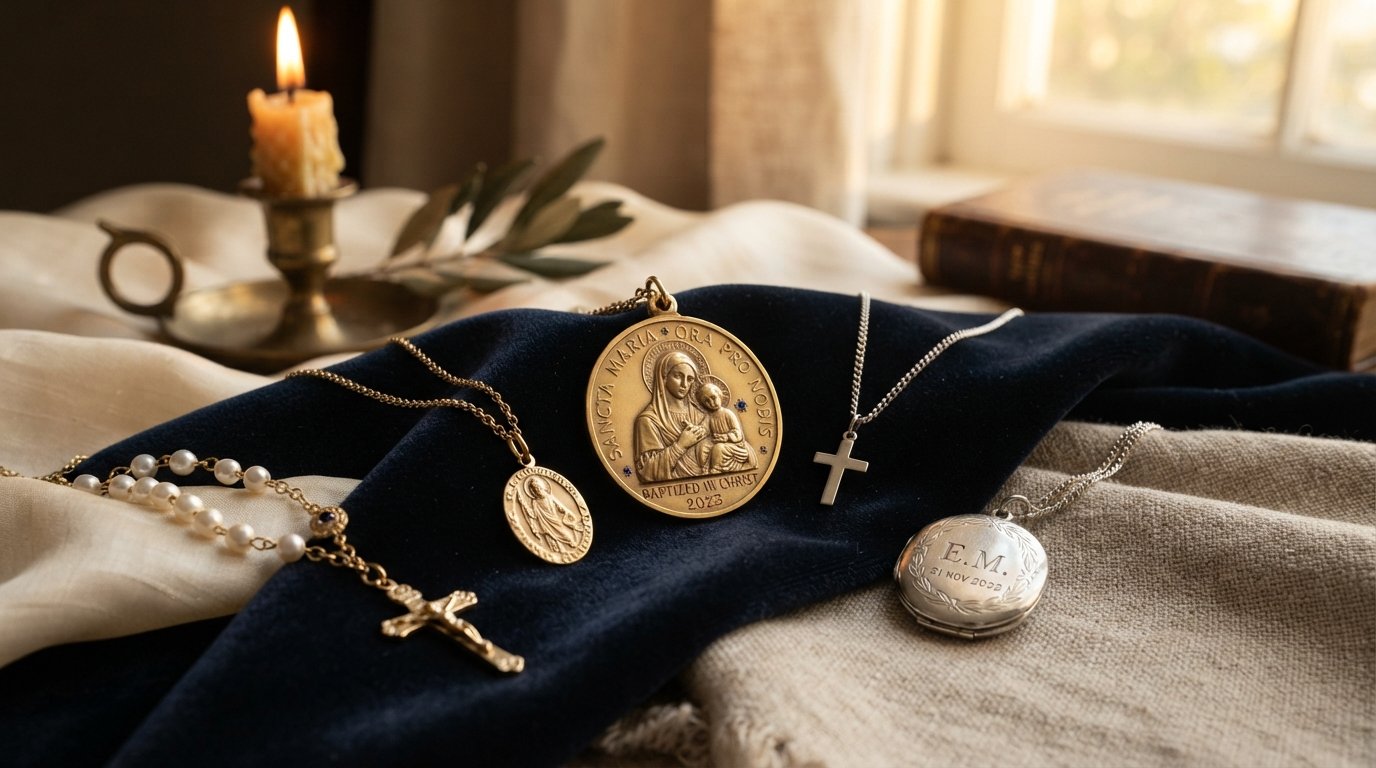
Mother-of-pearl is often found on christening and communion medallions, set in a gold or silver frame. It’s more fragile than solid metal and scratches if rubbed against a hard surface: best avoided during sports activities.
- 18-karat gold (750/1000): lasts over time, doesn’t tarnish, higher price.
- 9-karat gold (375/1000): good balance of durability and price, tone may shift.
- 925 solid silver: affordable, needs regular care.
- Gold-plated: thin layer of gold over a metal base, wears down over time.
What jewelry to give for a birth, christening or communion?
For a birth, a medallion and a fine chain remain the most popular choice: the chain is usually 40 to 45 cm for a child, with adjustment possible at the clasp. For a christening or communion, the emblem matters as much as the material. The Miraculous Medal, showing the Virgin Mary with open arms and rays of light, depicts the apparition reported by Catherine Labouré in 1830 on Rue du Bac in Paris; it’s one of the most requested emblems for this type of ceremony. The Virgin and Child, Christ, the angel or Saint Christopher, patron saint of travelers, are other classic emblems chosen according to the child’s name or family ties. An engraved ID bracelet with the child’s name often completes the gift.
Jewelry to engrave: what you need to know before choosing
A christening medallion is usually engraved on the back, typically with the child’s name and the date of the ceremony. Available space is limited on a 14 to 16 mm diameter: it’s best to plan for short, legible text rather than a full sentence. Larger diameters, 18, 20 or 22 mm, leave more room for a two-line engraving. This same personalization logic applies to customizable jewelry in other categories: rings or bracelets engraved with a name or a date.
Choosing jewelry based on budget and occasion
A solid silver necklace or pendant works well as a birthday gift without breaking the budget; 18-karat gold is better suited to pieces kept for a lifetime, such as a birth ID bracelet or christening medallion. For an academic or professional achievement, a discreet ring or a pair of earrings mark the occasion without overdoing it. In every case, a medallion’s diameter (14, 15, 16, 18, 20 or 22 mm) and its weight in grams remain the two key details to check before buying, far more reliable than a general description of the piece.
How do I choose the right size for a baptism medal?
Most baptism medals for babies measure 14 to 16 mm, which sits flat on a newborn’s chest without feeling heavy. Choose 18 to 20 mm for a child who will wear it later or for an adult keepsake. If you are buying a christening medal for a newborn, pair a 15 mm pendant with a 36 to 40 cm chain.
What is the difference between gold, gold-plated and sterling silver medals?
Solid 9k or 18k gold keeps its colour for decades and suits sensitive skin, but costs the most. Gold-plated pieces use a thin gold layer over brass or silver and may wear after years of daily contact. Sterling silver (925) is the usual middle ground: hypoallergenic gold baptism jewelry lasts longest, while silver stays affordable and easy to re-polish.
Which chain length and clasp are safest for a baby?
Use a 36 to 40 cm chain up to age three, then 42 to 45 cm. Pick a solid spring-ring or lobster clasp rather than a magnetic one, and check the jump ring is soldered closed. Many parents store the medal until the child is older; a safe baptism chain for infants should never be worn during sleep or bathing.
How do I clean and engrave a baptism medal?
Wipe silver and gold with a soft dry cloth after wear, and use lukewarm soapy water plus a soft brush for engraved grooves. Avoid ultrasonic cleaners on enamel or stone-set pieces. Engraving the reverse with the child’s first name and christening date is standard; ask before plating, since polishing an engraved christening medal later can soften shallow lettering.