
Boy's baptism chain
Choosing a boy’s baptism chain: link type, length and material
A baptism chain is chosen first by its link type, then by its material, and finally by its length. For a boy, three link types come up most often: the curb chain, with flat, interlocking links, sturdy and easy to engrave on the clasp; the figaro-style rolo link, round or filed, finer, which shows off a medal hanging at the centre; and the rope or marine link, twisted, which holds up well to everyday wear as the child grows. The choice mainly depends on use: a chain worn every day copes better with a tighter link like the curb chain, while a chain kept for special occasions can stay with a lighter rolo link.
925 silver, 9-carat gold or 18-carat gold: what actually changes
925 solid silver (92.5% pure silver) remains the most common choice for a child: light, rarely causing skin reactions, it cleans with a soft cloth and regains its shine without special treatment. 18-carat yellow gold (750/1000) has a richer tone and holds up better over time, but its weight and price per gram often make it a gift meant to last well beyond childhood. 9-carat gold (375/1000), more common among British jewellers than French ones, contains less pure gold and so costs less per gram, with a slightly paler tone. White gold, alloyed with palladium or nickel and then rhodium-plated, gives a cooler, more contemporary finish, suited to those who want to avoid traditional yellow.
What chain length for the child’s age
A chain that’s too long slips under clothing and gets forgotten, one that’s too short pulls with the slightest head movement. For a baby or young child, the following lengths cover most builds:
- 36 to 38 cm: for babies up to around 12 months
- 40 cm: for ages 1 to 3, the most requested length for a baptism
- 42 to 45 cm: for children aged 3 to 8, for a chain that will last several years
Many families buy a chain slightly longer than needed at the time of baptism, anticipating growth, rather than replacing it two years later.
Pairing the chain with a baptism medal or cross
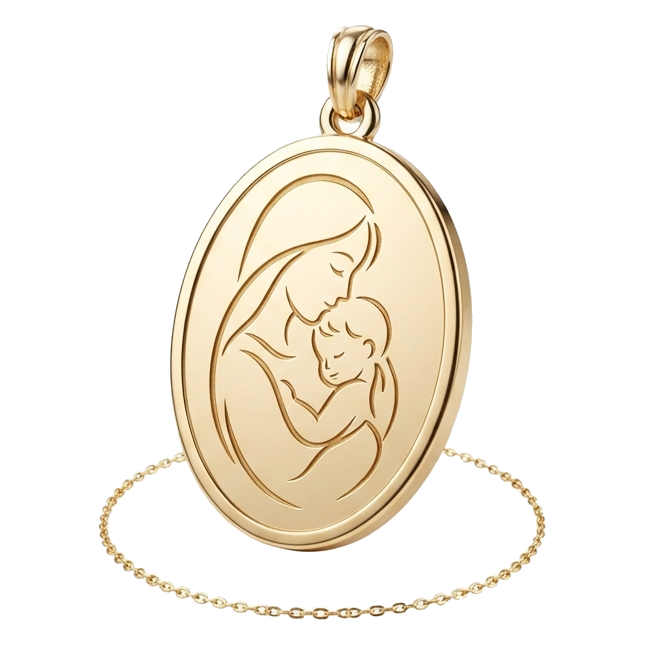
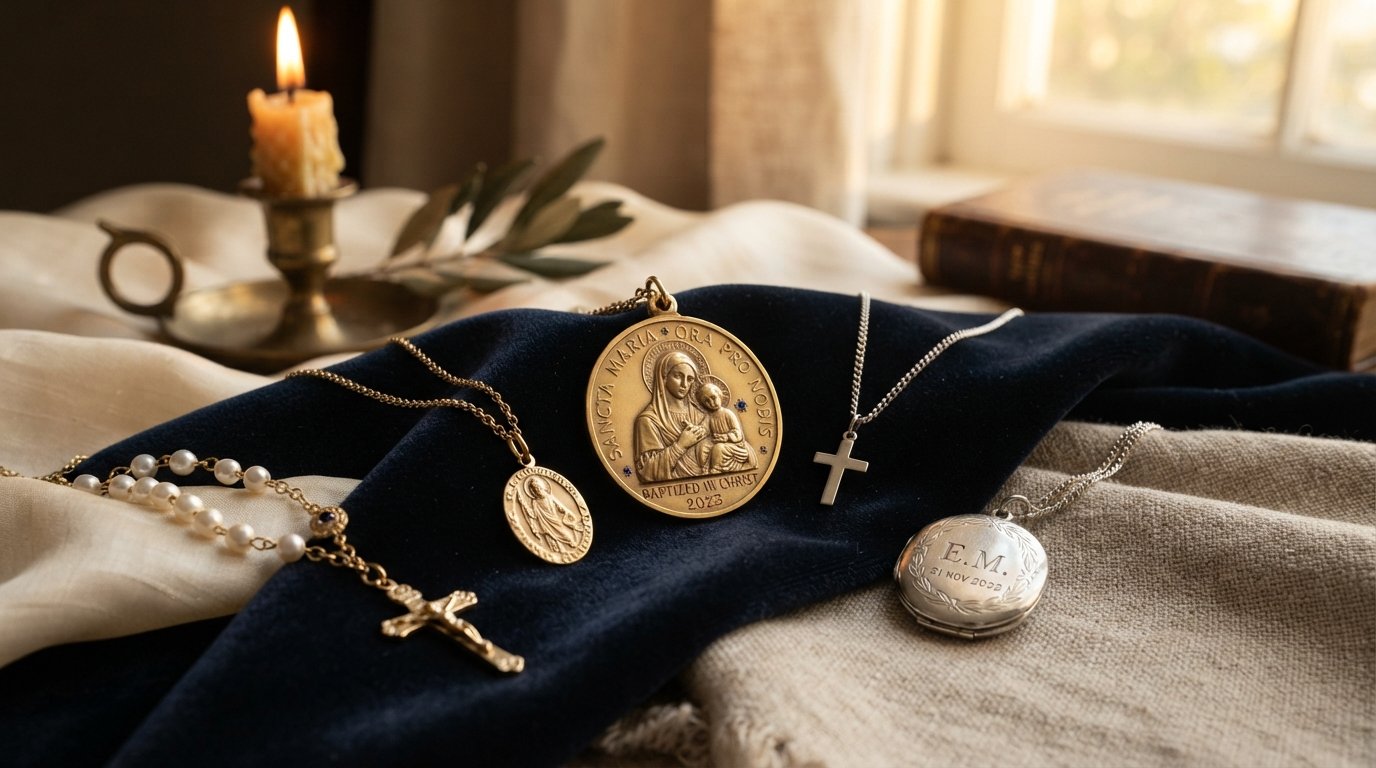
A chain on its own is rare for a baptism: it almost always comes with a baptism medal or a cross, chosen according to the image that matters to the family. The miraculous medal, showing the Virgin with open arms, takes its name from the apparition reported by Catherine Labouré on Rue du Bac in Paris in 1830; it remains one of the most requested designs for a baptism, alongside Christ, the guardian angel or the child’s patron saint. The medal’s diameter should stay in proportion with the chain’s link: a wide curb chain can carry an 18 to 20 mm medal, while a fine rolo chain pairs better with a 14 to 16 mm diameter, more discreet on a young child.
Engraving the first name on the back of the medal
A baptism medal is engraved on the back, usually with the child’s first name and the date of the ceremony. Available space stays limited on a 14 to 18 mm diameter: beyond around fifteen characters, the text becomes hard to read with the naked eye. Many families therefore stick to the first name alone, or the first name followed by the year, to keep the engraving crisp.
Completing the birth gift
A chain can also be paired with a larger piece of fine jewellery for families who want to mark the occasion beyond the piece itself: an engraved baptism curb bracelet for the wrist, a bracelet for the early years, or a signet ring meant to be worn much later, in the teenage years. These are complementary choices, not competing ones: the chain is worn around the neck from the first months, while the other pieces take over as the child grows.
Showing all 5 results
-

Curb chain – 18 carats
£545.99🛒 This product has multiple variants. The options may be chosen on the product page -

Curb chain – 9 carats
£214.99🛒 This product has multiple variants. The options may be chosen on the product page -

Fine curb chain – 18 carats
£300.99 -

Round cable chain – 18 carats
£351.99🛒 This product has multiple variants. The options may be chosen on the product page -

Round cable chain – 9 carats
£203.99🛒 This product has multiple variants. The options may be chosen on the product page
Choosing a boy’s baptism chain: link type, length and material
A baptism chain is chosen first by its link type, then by its material, and finally by its length. For a boy, three link types come up most often: the curb chain, with flat, interlocking links, sturdy and easy to engrave on the clasp; the figaro-style rolo link, round or filed, finer, which shows off a medal hanging at the centre; and the rope or marine link, twisted, which holds up well to everyday wear as the child grows. The choice mainly depends on use: a chain worn every day copes better with a tighter link like the curb chain, while a chain kept for special occasions can stay with a lighter rolo link.
925 silver, 9-carat gold or 18-carat gold: what actually changes
925 solid silver (92.5% pure silver) remains the most common choice for a child: light, rarely causing skin reactions, it cleans with a soft cloth and regains its shine without special treatment. 18-carat yellow gold (750/1000) has a richer tone and holds up better over time, but its weight and price per gram often make it a gift meant to last well beyond childhood. 9-carat gold (375/1000), more common among British jewellers than French ones, contains less pure gold and so costs less per gram, with a slightly paler tone. White gold, alloyed with palladium or nickel and then rhodium-plated, gives a cooler, more contemporary finish, suited to those who want to avoid traditional yellow.
What chain length for the child’s age
A chain that’s too long slips under clothing and gets forgotten, one that’s too short pulls with the slightest head movement. For a baby or young child, the following lengths cover most builds:
- 36 to 38 cm: for babies up to around 12 months
- 40 cm: for ages 1 to 3, the most requested length for a baptism
- 42 to 45 cm: for children aged 3 to 8, for a chain that will last several years
Many families buy a chain slightly longer than needed at the time of baptism, anticipating growth, rather than replacing it two years later.
Pairing the chain with a baptism medal or cross
A chain on its own is rare for a baptism: it almost always comes with a baptism medal or a cross, chosen according to the image that matters to the family. The miraculous medal, showing the Virgin with open arms, takes its name from the apparition reported by Catherine Labouré on Rue du Bac in Paris in 1830; it remains one of the most requested designs for a baptism, alongside Christ, the guardian angel or the child’s patron saint. The medal’s diameter should stay in proportion with the chain’s link: a wide curb chain can carry an 18 to 20 mm medal, while a fine rolo chain pairs better with a 14 to 16 mm diameter, more discreet on a young child.
Engraving the first name on the back of the medal
A baptism medal is engraved on the back, usually with the child’s first name and the date of the ceremony. Available space stays limited on a 14 to 18 mm diameter: beyond around fifteen characters, the text becomes hard to read with the naked eye. Many families therefore stick to the first name alone, or the first name followed by the year, to keep the engraving crisp.
Completing the birth gift
A chain can also be paired with a larger piece of fine jewellery for families who want to mark the occasion beyond the piece itself: an engraved baptism curb bracelet for the wrist, a bracelet for the early years, or a signet ring meant to be worn much later, in the teenage years. These are complementary choices, not competing ones: the chain is worn around the neck from the first months, while the other pieces take over as the child grows.
