Customizable gold-plated Josephine bangle

Build-your-own jewelry

Building a christening jewel: medal, chain and engraving in the right size

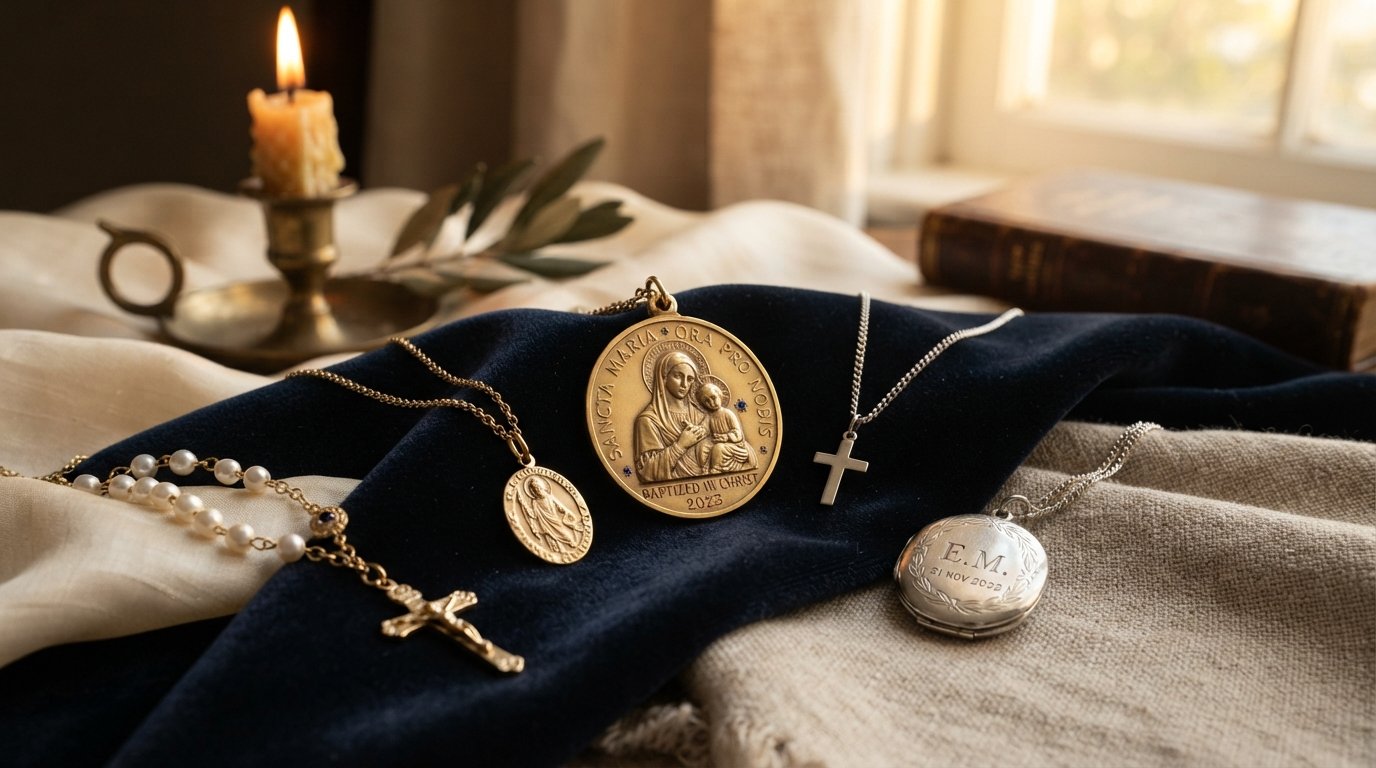
Building a christening jewel means making three independent choices: an image that means something to the family, a chain sized to fit a baby’s or child’s neck, and an optional engraving on the back. These three decisions aren’t always made in the same order, but they always come up: which design, which diameter, which material, which length.

Choosing the design based on the first name or patron saint

The Miraculous Medal shows the Virgin Mary with open arms, standing on the globe — a design inspired by an apparition reported by Catherine Labouré in 1830, and one of the most widely used designs in religious jewelry ever since. When the choice is tied to a first name, the logic changes: you look for the matching patron saint — Saint Christopher for a traveler, Saint Michael for a protector, Saint Therese for a figure of gentleness. The angel and the dove work well when no saint’s name applies, or for a birth without a strong religious background. The chrism symbol and the plain cross remain the most neutral designs, easy to wear well beyond childhood.

Diameter based on the child’s age

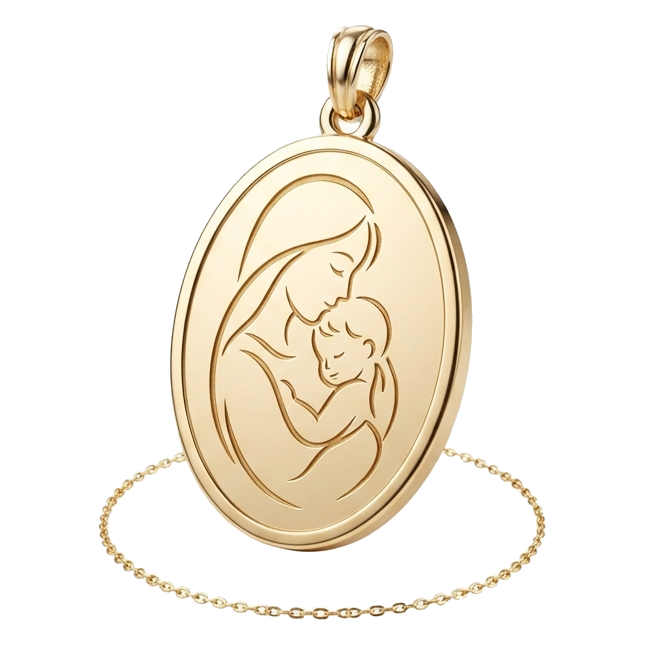
A diameter of 14 or 15 mm suits a newborn: the medal stays discreet and lightweight on a fine chain. From 18 mm, the design becomes easier to read — useful for a detailed image such as the Virgin and Child or a full-length saint. Beyond 20-22 mm, the piece moves past a child’s jewel into a size the wearer can keep into adulthood: a sensible choice if the medal is meant to last a lifetime rather than just the early years.

What material for a build-your-own christening jewel

18-carat (750/1000) yellow, white or rose gold is the benchmark material for a medal meant to last: it doesn’t oxidize and holds up well to daily contact with a child’s skin. 9-carat (375/1000) gold reduces the amount of pure gold in the alloy, which lowers the price per gram, at the cost of slightly lower resistance to wear. Solid 925 silver remains the most common choice for a first piece of jewelry: sturdy, but it should be rinsed after swimming in a pool or the sea to limit tarnishing from chlorine and salt. Vermeil — 925 silver plated with gold — mimics the look of gold with far less gold by weight, though the plating fades after several years of continuous wear.

Chain, link and length suited to a child

A child’s chain should be between 40 and 45 cm: any shorter and it tightens around the neck as the child grows; any longer and the medal hangs too low and catches on clothing. The curb (forçat) chain, with tight round links, is the sturdiest option for everyday wear. The rope (jaseron) chain, twisted, is finer and suits a lightweight medal. The flat, wide marine link catches the light better but adds weight to the piece — a choice better suited to an adult chain kept for later. The omega chain, smooth and with no visible links, is the most comfortable against sensitive skin but also the hardest to repair if a link gets damaged.

Engraving on the back of the medal

A christening medal is usually engraved on the back with the child’s first name and christening date. Available space is limited: on a 14 to 16 mm diameter, only a few characters fit legibly, which often means choosing between the full first name and a shortened date rather than spelling out both in full. On an 18 mm diameter and above, both pieces of information fit more comfortably. Engraving too much text on a small diameter ends up illegible to the naked eye — worth keeping in mind before finalizing the wording.

Frequently asked questions

Should the medal and chain be made of the same material?

It isn’t technically required, but mixing gold and silver means the two oxidize at different rates and can create a visible color contrast after a few years. Matching both avoids this gradual mismatch.

Which design should I choose if there’s no matching saint’s name?

The angel, the dove or the plain cross work for any first name, without a direct link to a specific patron saint. They’re also the easiest designs to wear into adulthood without looking childish.

Is a 14 mm medal too small to last over time?

It’s perfectly suited to the early years, but a detailed design loses clarity at that size. For a jewel meant as a lasting keepsake rather than just a child’s accessory, a diameter of 18 mm or more keeps the design crisp for longer.

Can the chain be replaced later without changing the medal?

Yes: the medal and chain are chosen independently, and a 40-45 cm chain that becomes too short can simply be swapped for an adult length, without touching the existing design or engraving.

Showing the single result

Building a christening jewel: medal, chain and engraving in the right size

Building a christening jewel means making three independent choices: an image that means something to the family, a chain sized to fit a baby’s or child’s neck, and an optional engraving on the back. These three decisions aren’t always made in the same order, but they always come up: which design, which diameter, which material, which length.

Choosing the design based on the first name or patron saint

The Miraculous Medal shows the Virgin Mary with open arms, standing on the globe — a design inspired by an apparition reported by Catherine Labouré in 1830, and one of the most widely used designs in religious jewelry ever since. When the choice is tied to a first name, the logic changes: you look for the matching patron saint — Saint Christopher for a traveler, Saint Michael for a protector, Saint Therese for a figure of gentleness. The angel and the dove work well when no saint’s name applies, or for a birth without a strong religious background. The chrism symbol and the plain cross remain the most neutral designs, easy to wear well beyond childhood.

Diameter based on the child’s age

A diameter of 14 or 15 mm suits a newborn: the medal stays discreet and lightweight on a fine chain. From 18 mm, the design becomes easier to read — useful for a detailed image such as the Virgin and Child or a full-length saint. Beyond 20-22 mm, the piece moves past a child’s jewel into a size the wearer can keep into adulthood: a sensible choice if the medal is meant to last a lifetime rather than just the early years.

What material for a build-your-own christening jewel

18-carat (750/1000) yellow, white or rose gold is the benchmark material for a medal meant to last: it doesn’t oxidize and holds up well to daily contact with a child’s skin. 9-carat (375/1000) gold reduces the amount of pure gold in the alloy, which lowers the price per gram, at the cost of slightly lower resistance to wear. Solid 925 silver remains the most common choice for a first piece of jewelry: sturdy, but it should be rinsed after swimming in a pool or the sea to limit tarnishing from chlorine and salt. Vermeil — 925 silver plated with gold — mimics the look of gold with far less gold by weight, though the plating fades after several years of continuous wear.

Chain, link and length suited to a child

A child’s chain should be between 40 and 45 cm: any shorter and it tightens around the neck as the child grows; any longer and the medal hangs too low and catches on clothing. The curb (forçat) chain, with tight round links, is the sturdiest option for everyday wear. The rope (jaseron) chain, twisted, is finer and suits a lightweight medal. The flat, wide marine link catches the light better but adds weight to the piece — a choice better suited to an adult chain kept for later. The omega chain, smooth and with no visible links, is the most comfortable against sensitive skin but also the hardest to repair if a link gets damaged.

Engraving on the back of the medal

A christening medal is usually engraved on the back with the child’s first name and christening date. Available space is limited: on a 14 to 16 mm diameter, only a few characters fit legibly, which often means choosing between the full first name and a shortened date rather than spelling out both in full. On an 18 mm diameter and above, both pieces of information fit more comfortably. Engraving too much text on a small diameter ends up illegible to the naked eye — worth keeping in mind before finalizing the wording.

Frequently asked questions

Should the medal and chain be made of the same material?

It isn’t technically required, but mixing gold and silver means the two oxidize at different rates and can create a visible color contrast after a few years. Matching both avoids this gradual mismatch.

Which design should I choose if there’s no matching saint’s name?

The angel, the dove or the plain cross work for any first name, without a direct link to a specific patron saint. They’re also the easiest designs to wear into adulthood without looking childish.

Is a 14 mm medal too small to last over time?

It’s perfectly suited to the early years, but a detailed design loses clarity at that size. For a jewel meant as a lasting keepsake rather than just a child’s accessory, a diameter of 18 mm or more keeps the design crisp for longer.

Can the chain be replaced later without changing the medal?

Yes: the medal and chain are chosen independently, and a 40-45 cm chain that becomes too short can simply be swapped for an adult length, without touching the existing design or engraving.

Related categories

Categories
Our Christening Jewe... 176 Christening Medals 133 18K Yellow Gold Chri... 92 Jewelry 76 Boy's Baptism Medal 76 Girl's Baptism Medal 74 Gold Jewelry 64 Communion Gifts 61 Christmas selection 61 Gift for Mom 58 Mother's Day gifts 55 Confirmation Gifts 54 Our New Arrivals 47 Communion Gifts for ... 46 Our Gift Ideas 46 Virgin and Child Bap... 45 Gold Bracelet 40 Valentine's Day Sele... 39 Necklace 38 Affordable Christeni... 33 All products
🏠 Home 🛍️ Products 📋 Categories 🛒 Cart