Medal Bracelet
Showing all 10 results
-

Botticelli Madonna gold medal bracelet – 18 carats
-

Botticelli’s Madonna gold medal bracelet – 9 carats
-

Diamond medal bracelet – 18 carats
-

Our Lady of Wisdom portrait medal bracelet – 18 carats
-

Radiant Virgin and Child gold medal bracelet – 18 carats
-

Radiant Virgin and Child gold medal bracelet – 9 carats
-

Radiant Virgin and Child medal bracelet – 18 carats
-

Sweet Mother gold medal bracelet – 18 carats
-

Sweet Mother gold medal bracelet – 18 carats
-

Sweet Mother gold medal bracelet – 9 carats
Choosing a christening medal bracelet: the criteria that matter
A christening medal bracelet pairs a fine chain with a religious pendant, usually a round or oval medal 14 to 18 mm in diameter. Unlike a necklace, worn on the wrist, it stays visible at all times and wears differently: the medal rubs against the skin, and the clasp gets handled more often. Three questions guide the choice: the design (which saint, which representation of Mary), the material (18 carat gold, 9 carat gold or silver), and the chain length suited to the age of the wrist that will wear it.
Which design for which name or patron saint
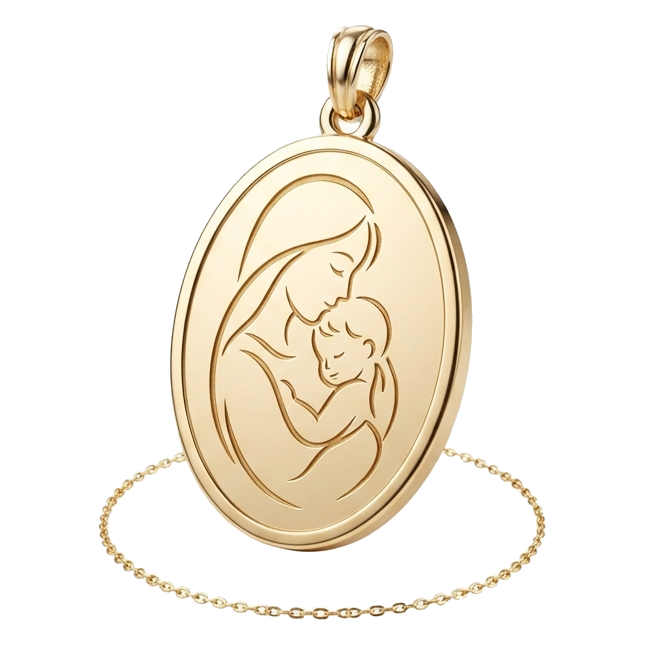
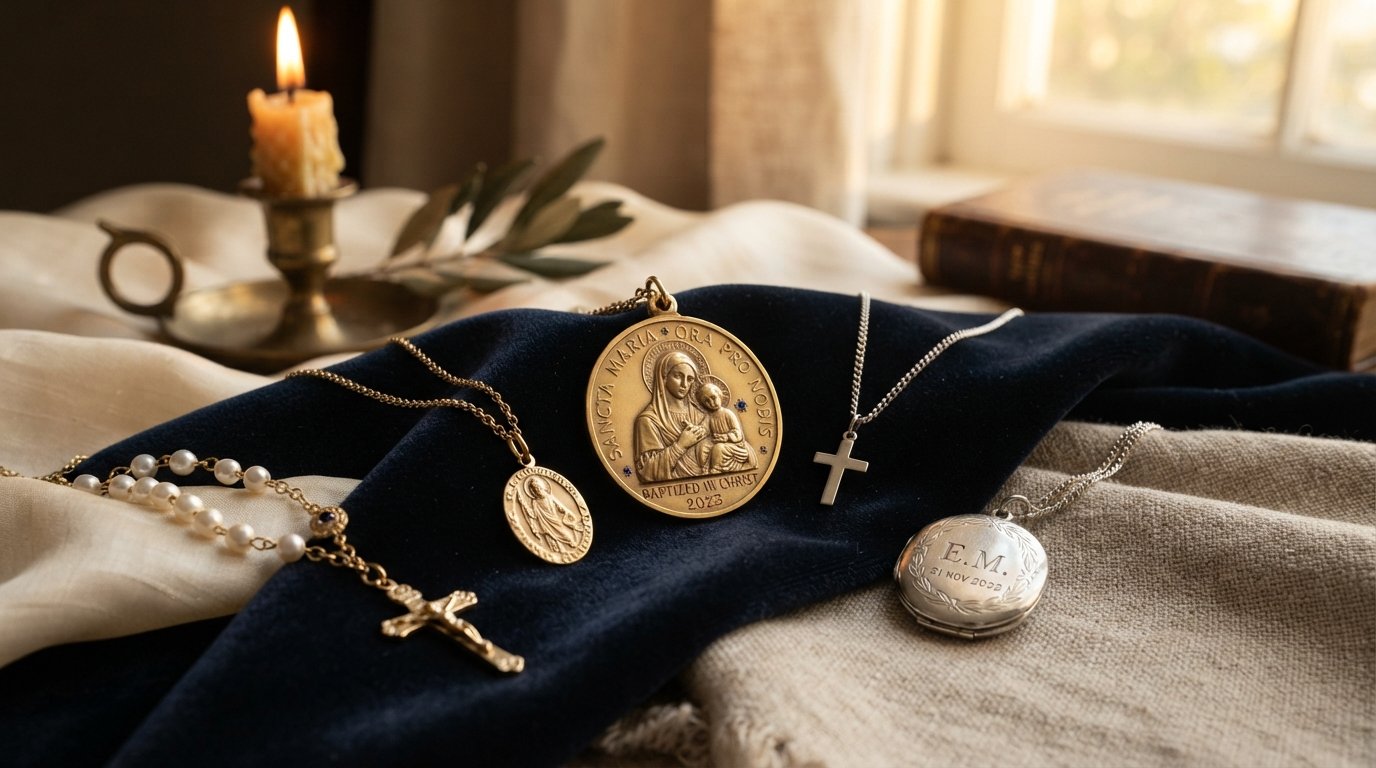
The Virgin and Child remains the most requested design for a christening, engraved in more or less elaborate forms depending on the founder. It evokes Mary’s motherhood and suits a child without needing a direct link to a specific first name. For a more personal choice, families turn to the patron saint of the child’s first name: Saint Christopher for a traveler, Saint Michael for a protector, Saint Theresa for a name built around Theresa. The miraculous medal, inscribed “O Mary conceived without sin,” refers to the apparition reported by Catherine Labouré in 1830: it is chosen independently of the first name, as a general Marian symbol rather than a patronage.
Alternative symbols to a saint’s image
The tree of life, the dove or the chrism suit families who want a christening to be marked but with less figurative imagery than a saint’s face. The chrism, a monogram of Christ formed from the Greek letters chi and rho, is mainly recognized by those familiar with the symbol: best reserved for cases where the christened child’s religious circle will recognize it.
18 carat gold, 9 carat gold or silver: what changes
18 carat gold (750/1000) contains 75% pure gold, the rest being a copper and silver alloy that gives it strength. It is the benchmark for a piece of jewelry meant to be worn for life and passed down. 9 carat gold (375/1000) contains only 37.5% gold: more affordable and also harder, it suits a child’s bracelet that will be resized several times before adulthood. Solid 925 silver (92.5% pure silver) offers a lighter, less expensive bracelet, but it tarnishes on contact with perspiration and needs regular cleaning with a soft cloth. Vermeil, solid silver coated in gold, mimics the look of gold, provided you accept that the gilding fades over the years.
Medal diameter, weight and chain length
For an infant, a 14 or 15 mm medal stays proportionate to the wrist and limits the risk of catching. From around 3-4 years old, a diameter of 16 to 18 mm becomes legible without looking oversized. Beyond 20 mm, the medal is better suited to a teenager or adult who wears it as a pendant rather than on the wrist. Weight ranges from 1 to 4 grams depending on the thickness of the strike: a matte sandblasted medal generally weighs a little less than a solid mirror-polished medal of the same diameter. As for the chain, an infant’s wrist measures about 10 to 12 cm, a 5-year-old’s around 14 cm: it’s better to choose an adjustable or slightly longer chain, with an extension link, rather than a fixed length that becomes unusable within a few months.
Sandblasted, polished or hammered: engraving legibility
A matte sandblasted finish catches less light and keeps an engraving more legible in all circumstances. A mirror-polished finish highlights the relief of the design but shows micro-scratches more over time. The hammered finish, rarer on this type of medal, mainly suits models without an engraving on the back.
Engraving on the back of the medal
A christening medal is engraved on the back, usually on a surface of just a few millimeters, which limits the text to a short first name or initials followed by a date in DD/MM/YY format. Two styles of lettering dominate among engravers: block script, in upright capitals, more legible on a small surface, and script, cursive, which needs more space to stay clear. A first name of more than eight letters rarely fits well in script on a 14 mm medal: block lettering is then the safer choice.
Wearing the bracelet alone or layered
The medal bracelet can be worn alone for discreet everyday use, or paired with a pendant of the same design to mark the occasion further. When layered with other fine bracelets, it loses its status as a standalone religious piece and becomes part of a stacked look: in that case, a curb or rope chain, flatter in profile, combines better with other pieces than a thicker marine-link chain, which is more visible on its own.