Mother's Day gifts
Showing 37–55 of 55 results
-

Open cross decade ring in gold – 18 carats
-

Open Miraculous Medal decade ring in gold – 18 carats
-

Openwork cross – 18 carats
-

Openwork Tree of Life pendant – 18 carats
-

Oval jaseron chain bracelet – 18 carats
-

Radiant Heart christening medal – 18 carats
-

Radiant Virgin and Child christening medal – 9 carats
-

Radiant Virgin and Child gold medal bracelet – 9 carats
-

Raphael’s Angel christening medal – 18 carats
-

Roman cross mother of pearl and gold earrings – 18 carats
-

Roman cross mother of pearl earrings – 18 carats
-

Small diamond medal pendant – 18 carats
-

Star Medal – 18 carats
-

Stick cross – 9 carats
-

Sweet Mother christening medal – 9 carats
-

Sweet Mother gold medal bracelet – 9 carats
-

Sweet Mother mother of pearl christening medal
-

Yellow gold crowned pearl earrings – 18 carats
-

Yellow gold pearl drop earrings – 18 carats
A piece of jewelry for Mother’s Day, not just another interchangeable gift
Choosing jewelry for Mother’s Day means picking a piece with real meaning, not a generic item pulled off a catalogue page. In this selection, the engraving, the material and the design matter far more than size or looks: it’s the combination of all three that turns a pendant or medal into a truly personal gift, designed for a mother and for the story of her children.
Which design to choose for a mother
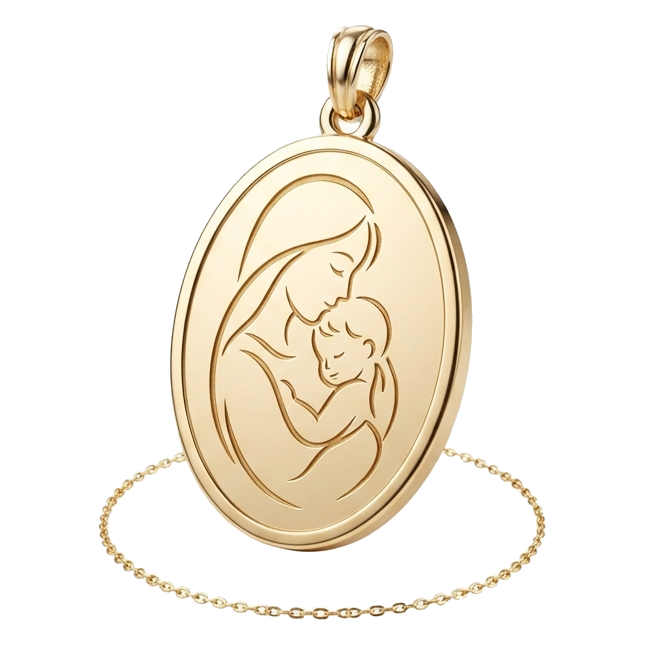
Some designs speak directly to motherhood and family ties. The Virgin and Child remains the most requested design for this occasion: it explicitly represents the mother-child bond, unlike a Saint Therese or Saint Christopher medal, which refer to other forms of protection. The Miraculous Medal, featuring the Virgin Mary, takes its name from the apparitions reported by Catherine Labouré in 1830 — a documented historical fact, not a marketing claim, which explains why this design remains a classic passed down from mother to daughter.
Symbols of family and legacy
The tree of life works beautifully as a Mother’s Day gift because it reads almost like a family tree: the branches represent the children, the root represents the mother. The dove and the angel are more understated choices, often preferred for a discreet piece with no strong religious symbolism. The chrism and the cross remain fitting for a practising mother, but appeal to a narrower audience than the tree of life or the Miraculous Medal.
Gold, silver or vermeil: what it actually changes
18-carat yellow, white or rose gold (750/1000) is the standard for a piece meant to be worn daily for years to come: it doesn’t tarnish and keeps its colour. 9-carat gold (375/1000) contains less precious metal and costs less for the same weight, with a slightly paler tone. Sterling silver 925 is well suited to occasional wear or a first piece of jewelry, provided you’re prepared for more regular upkeep: it tarnishes on contact with air and perspiration. Vermeil — silver plated with gold — sits between the two: the look of gold, the upkeep of silver.
Engraving a name or a date: what the space actually allows
A 16mm medal only leaves room for a short name or a date in day/month/year format; beyond that, the characters become unreadable to the naked eye. On an 18mm or 20mm piece, a full birth date can be added on the back without crowding the front. Engraving is done on the back of the medal, never on the design itself: this is standard practice for this type of jewelry, distinct from a separate service or add-on.
Choosing the right diameter and length
- 14-15 mm: discreet, suited to a fine chain worn every day
- 16-18 mm: the most common size, readable without being oversized
- 20-22 mm: more eye-catching, best kept for occasional wear or for those who like bold pieces
- Chain: a length of 42 to 45 cm suits most adults, versus 40 to 45 cm for a child’s piece
Chain link and finish: a difference you can see when worn
The curb chain is the simplest and sturdiest option for everyday wear. The rope chain, finer and shinier, shows off a small-diameter medal to better effect. The figaro chain and the omega chain are wider and suit a larger pendant. As for finish, a matte sandblasted texture hides everyday micro-scratches better than a high-polish finish, while a hammered finish adds texture to an otherwise flat surface. These three factors — diameter, chain link and finish — shape the final result even more than the choice of design itself.
What makes a christening medal a good Mother’s Day gift?
A baptism medal works for Mother’s Day when it marks her child’s christening date or initials. Choose a 16–18 mm sterling silver or 9K gold medal engraved on the reverse with the birth date. Many mothers wear it on a 45 cm chain alongside their own pendant, making it a personalised christening medal gift for mum rather than a keepsake stored in a box.
Should I choose silver or gold for a medal my mother will wear daily?
Sterling silver (925) costs less and suits cool skin tones, but it tarnishes and needs polishing every few months. 9K or 14K gold resists tarnish and handles daily wear, showers and perfume without dulling. If she already wears yellow gold earrings or a wedding band, matching the metal avoids clashing. Gold vermeil sits between the two: silver base, 2.5-micron gold layer.
How long does engraving take and what can I fit on the back?
Engraving adds 2 to 5 working days before dispatch, so order at least a week before Mother’s Day. On an 18 mm medal, the reverse holds roughly 20–25 characters across two lines: a first name and a date, or initials and a short word. Cursive script fits fewer characters than block capitals. Engraved medals are usually non-returnable, so check spelling twice.
How do I clean a christening medal without damaging it?
Wipe it with a dry microfibre polishing cloth after wearing. For tarnished silver, use lukewarm water with mild soap and a soft brush, then dry fully. Avoid ultrasonic cleaners and chemical dips on enamelled or gem-set medals, as they lift enamel and loosen settings. Storing the medal in a small anti-tarnish pouch between wears is the simplest way to care for a baptism medal long term.