
Women's Gold Bracelet
Showing all 16 results
-

Botticelli Madonna gold medal bracelet – 18 carats
-

Classic gold bangle – 18 carats
-

Diamond medal bracelet – 18 carats
-

Family yellow gold bracelet – 18 carats
-

Heritage yellow gold bangle – 18 carats
-

Honorine bracelet – 9 carats
-

Miraculous gold bracelet – 18 carats
-

Miraculous medal and cross decade bracelet – 18 carats
-

Mother of pearl chain bracelet on round curb chain – 18 carats
-

Mother of pearl Roman cross bracelet on round curb chain – 18 carats
-

Our Lady of Wisdom portrait medal bracelet – 18 carats
-

Radiant Virgin and Child gold medal bracelet – 18 carats
-

Radiant Virgin and Child medal bracelet – 18 carats
-

Roman cross bracelet – 18 carats
-

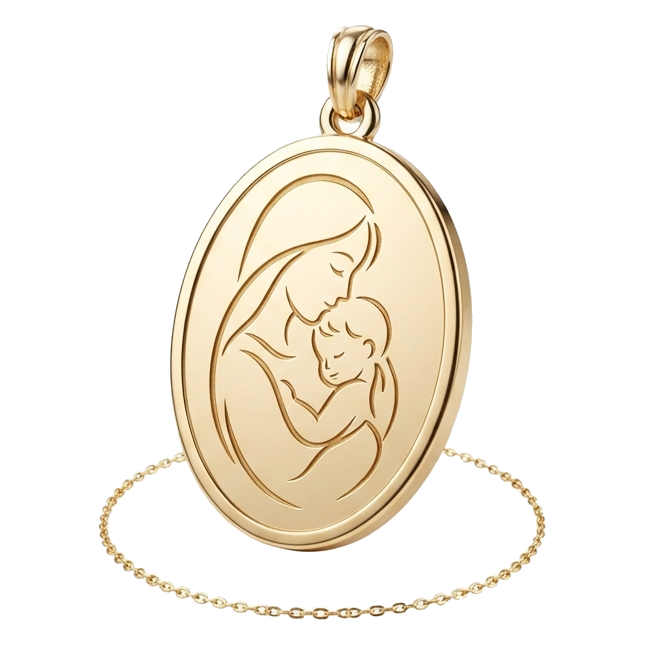
Sweet Mother gold medal bracelet – 18 carats
-

Sweet Mother gold medal bracelet – 18 carats
Women’s gold bracelets: which carat and hallmark to choose
A women’s gold bracelet is chosen first and foremost on the basis of the metal’s hallmark, expressed in carats. 18-carat gold (750/1000) remains the standard in French women’s jewellery: 75% pure gold alloyed with silver or copper depending on the desired shade. Yellow gold blends copper and silver in equal proportions, rose gold emphasises copper, and white gold is alloyed with palladium or nickel before being finished with a rhodium plating that gives it its cool shine. 9-carat gold (375/1000) costs less for the same weight but contains under 40% pure gold: the shade is paler and the alloy more likely to trigger skin reactions in sensitive skin. Vermeil, 925 silver coated with a layer of gold, offers the look of a gold piece at a lower budget, though the coating wears down over time depending on how often it’s worn.
Chain links and finishes: what changes for everyday wear
The chain link determines both the look and the durability of the bracelet. The curb link, made of round links soldered one by one, holds up well to repeated friction and suits everyday wear. The rope (jaseron) link, finer and more supple, tends to be worn as a discreet piece, sometimes layered with other bracelets. The marine (figaro-style) link, with flat, crossed links, adds visible width without excess weight. The ID chain link, meanwhile, stands out for its flattened links that create a flat surface: this is the shape best suited to engraving, whether on the central plate or on a widened link.
Sandblasted, polished or hammered finish
A matte sandblasted finish diffuses light and hides micro-scratches better than a glossy polished finish, which is more classic but requires more upkeep. The hammered finish, achieved through small, regular impacts on the metal’s surface, creates a textured relief that breaks up the uniform reflections of a smooth chain.
What wrist length for a women’s gold bracelet
An adult women’s bracelet is generally chosen between 16 and 19 cm depending on wrist shape, compared with 12 to 14 cm for a child’s bracelet. Measuring the wrist with a tape and adding 1.5 to 2 cm gives a comfortable fit, neither too tight nor loose past the wrist bone. Extension chain styles, usually with an extra 2 to 3 cm and a small charm at the end of the chain, allow the bracelet to be adjusted for natural wrist swelling throughout the day.
Clasps: lobster clasp, spring ring or box clasp
The lobster clasp remains the most common on lightweight bracelets: easy to operate with one hand thanks to its spring-loaded lever. The spring ring, smaller, is typically found on fine chains such as the rope link. On heavier ID chains, a double-security box clasp reduces the risk of accidental opening — worth checking before purchase if the bracelet is meant for daily wear rather than occasional use.
Engraving a women’s gold bracelet: first name, date, initial
Engraving is done on the back of the plate, on a widened link or on the clasp, depending on the model. Available space sets a real limit: a short first name and a date in day/month/year format fit easily on a classic ID bracelet plate, while a longer name may require smaller lettering or limiting the engraving to a single initial. Fine engraving reads well up close but fades visually from a distance, making it a choice suited to a piece meant to be kept and looked at closely rather than a statement piece of jewellery.
What occasion calls for a gold bracelet
A women’s gold bracelet marks specific moments: a godmother’s gift for a christening, a communion present, the birth of a child celebrated with a piece of jewellery for the mother, or a birthday. The choice of carat and chain link then depends less on trend and more on intended use: a fine 18-carat piece for discreet daily wear, or a wider, engraved ID bracelet for a piece meant to commemorate a specific date.
- 18-carat gold (750/1000): rich shade, stable alloy, the standard in women’s jewellery
- 9-carat gold (375/1000): lower budget, paler shade, alloy more likely to react with sensitive skin
- Curb or marine link: resistant to everyday wear
- ID chain link: flat surface suited to engraving
- 16-19 cm length: standard adult range, to be adjusted to actual wrist size
How do I choose the right size for a women’s gold bracelet?
Measure your wrist with a tape or strip of paper, then add 1.5 cm for a comfortable chain bracelet or 1 cm for a snug fit. Most women’s sizes fall between 17 and 19 cm. For a christening gift, a 14–16 cm bracelet suits a child, and adjustable sliding clasps let the piece grow with the wearer.
What is the difference between solid gold and gold-plated bracelets?
Solid gold, usually 9k, 14k or 18k, keeps its colour permanently and can be resized or repaired by a jeweller. Gold-plated pieces have a thin gold layer over brass or silver that wears down after a year or two of daily use. If you want a gold baptism bracelet for a child to keep into adulthood, solid gold is the safer investment.
Can a gold bracelet be worn with a christening medal?
Yes. Many buyers pair a fine curb or figaro chain bracelet with a small engraved medal, worn on the wrist rather than the neck for infants. Choose a bracelet with a jump ring or a lobster clasp so the medal can be attached and removed. Keep the medal under 12 mm so it lies flat and does not catch on clothing.
How should I clean and store a gold bracelet?
Soak it a few minutes in warm water with a drop of mild washing-up liquid, brush the links with a soft toothbrush, rinse and dry with a lint-free cloth. Avoid chlorine, perfume and household cleaners, which dull the finish. Store each piece separately in a soft pouch to prevent scratching, and remove it before swimming or sleeping.