Mini Baptism Medals
Showing all 8 results
-

Holy Spirit christening medal – 18 carats
-

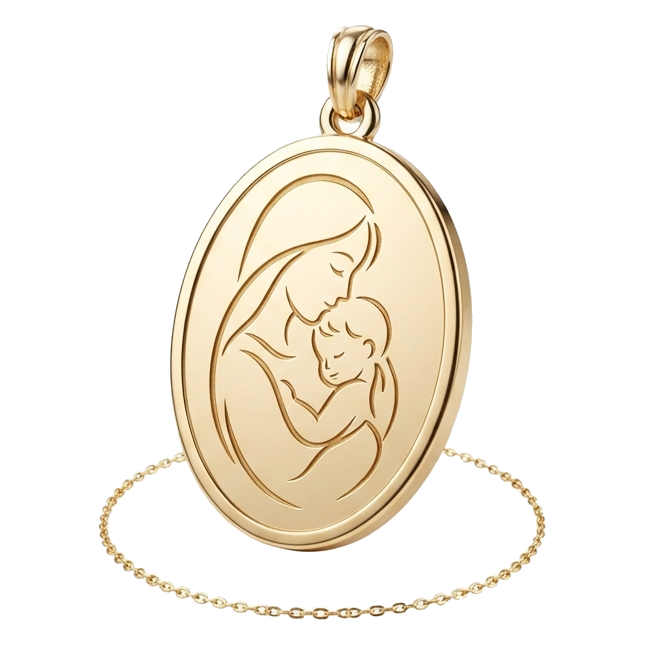
Maternity christening medal – 18 carats
-

Mini Ecce Homo christening medal – 18 carats
-

Mini Raphael Angel christening medal – 18 carats
-

Mini Saint John the Baptist christening medal – 18 carats
-

Mini Virgin with Briar Rose christening medal – 18 carats
-

Sacred Heart christening medal – 18 carats
-

Saint Joseph christening medal – 18 carats
The mini format: what diameter for a baptism medal
A mini medal ranges between 10 and 14 mm in diameter, compared to 14 to 22 mm for a classic baptism model. This smaller size changes everything about how it’s worn: the piece can be worn every day without weighing on a newborn’s neck, and it slips just as easily onto a chain as onto a bracelet. In 18-carat gold (750/1000), a mini medal typically weighs between 0.5 and 1.5 grams depending on the thickness and design.
For a medal intended for the baptism day itself, it’s best to choose the largest diameter in the mini range, around 14 mm: the engraving will be more legible and the piece visible without being oversized. For a bracelet charm, where several charms often sit side by side, a smaller size, 10 or 12 mm, remains visually more balanced.
On a bracelet or a birth ribbon
The mini medal lends itself particularly well to a birth gift. Mounted on a ribbon, it decorates a crib or cradle; soldered onto a gold curb bracelet, it becomes a piece of jewelry the child will wear later on. This format is also used to mark the place of an unborn child within a family, with a first name or a simple cross engraved as a tribute.
Choosing the design: Virgin Mary, angel, cross or patron saint
The choice of design generally follows one of two logics: the link to the child’s first name, or the family’s attachment to a specific representation. The Virgin and Child and the Virgin Mary alone remain the most requested designs for a baptism. The angel and the dove suit a birth or a civil baptism, without a strong religious connotation. The cross and the chrism appeal to families looking for a more understated symbol.
The miraculous medal holds a special place: its design dates back to 1830, following an apparition reported by the nun Catherine Labouré, and it remains one of the most engraved designs in France ever since. For a child bearing the name of a specific saint, mini medals also come in patron saint versions: Saint Christopher for a child born while traveling or into a family that travels often, Saint Michael or Saint Benedict for a symbol of protection, Saint Joseph to honor a father or grandfather with the same name, Saint Therese for a little girl.
- Virgin and Child / Virgin Mary: the most classic choice for a Catholic baptism
- Angel or dove: a design suited to a birth, without a strict religious reading
- Miraculous medal: a dated and recognized design, very popular for name engraving
- Patron saint: relevant when it matches the first name of the child or a loved one
925 silver, 9 or 18-carat gold: what the material changes
Solid 925 silver offers the advantage of price and a bright finish, but it tarnishes on contact with air and moisture and requires regular upkeep. 9-carat gold (375/1000) and 18-carat gold (750/1000) do not oxidize: the difference between the two lies in the proportion of pure gold, and therefore in the color, density and resistance to wear over several decades. Vermeil, silver coated with a thin layer of gold, replicates the look of gold at a lighter weight, which matters for a medal intended for a very young child.
For a piece meant to last a lifetime, 18-carat gold remains the most durable choice. For a piece worn occasionally or kept in a drawer until the child grows up, 925 silver or vermeil is more than sufficient.
Pairing the medal with a chain or bracelet
A mini medal pairs well with a fine chain, most often in curb link, whose weight stays proportionate to the pendant so as not to unbalance it. For a child, the standard chain length ranges from 40 to 45 cm. The more textured rope chain, or the wider figaro chain, suit an adult wearer who takes over the medal later on better.
Mounted on a bracelet, the medal pairs with a slim, flexible bangle without a complex clasp for a newborn’s wrist, or with an oval-link bracelet that can hold several charms over the years. The omega chain, more rigid, remains reserved for adult bracelets and chains.
Engraving on a mini medal: what the format allows
On a diameter of 10 to 14 mm, the space available for engraving is limited: a short first name, initials or a date in DD/MM/YY format fit legibly, but a long first name combined with a full date quickly overcrowds the back of the medal. A baptism medal is traditionally engraved on the back, with the child’s first name and the date of the ceremony; for the smallest models, it’s best to reserve the engraving for initials to keep a clean result.
This choice therefore depends on the diameter selected: the smaller the medal, the shorter the engraved text must stay to remain legible to the naked eye.