
Baptism Medal Saints
Showing all 23 results
-

Holy Family at the Workshop christening medal – 18 carats
-

Holy Family christening medal – 18 carats
-

Holy Family christening medal – 9 carats
-

Holy Spirit christening medal – 18 carats
-

Loving Holy Family christening medal – 18 carats
-

Mary and Joseph christening medal – 18 carats
-

Mini Saint John the Baptist christening medal – 18 carats
-

Nativity christening medal – 18 carats
-

Sacred Heart and Crowned Virgin scapular – 18 carats
-

Saint Anthony of Padua christening medal – 18 carats
-

Saint Anthony of Padua with Lily christening medal – 18 carats
-

Saint Benedict medal patron of Christendom – 18 carats
-

Saint Christopher christening medal – Christ-bearer – 18 carats
-

Saint Esprit Vini Sancte Spiritus christening medal – 18 carats
-

Saint George christening medal – 18 carats
-

Saint Joseph christening medal – 18 carats
-

Saint Joseph christening medal – 9 carats
-

Saint Joseph of the Lilies christening medal – 18 carats
-

Saint Joseph the Protector christening medal – 18 carats
-

Saint Joseph the Protector christening medal – 9 carats
-

Saint Joseph the Protector portrait christening medal – 18 carats
-

Saint Joseph the Protector portrait christening medal – 9 carats
-

Saint Michael christening medal – 18 carats
Choosing a baptism medal featuring a patron saint
A saint medal is chosen based on three practical criteria: the engraving, which matches the godchild’s first name or intention; the diameter, which depends on the wearer’s age; and the material, which determines the weight and upkeep. Classic designs measure 16 or 18 mm in diameter, the most common size for a baptism. The 14 mm size, known as a mini medal, suits a very young child or someone who prefers a discreet piece; you’ll find it in our mini medals selection.
When it comes to material, 18-karat yellow gold (750/1000) remains the reference for a saint medal: it doesn’t tarnish, withstands prolonged contact with an infant’s skin, and can be passed down without losing its shine. 9-karat gold (375/1000) offers a more accessible budget for an equivalent diameter, at the cost of a lower gold content. Solid 925 silver and vermeil (gold-plated silver) suit a piece worn daily without the constraints of yellow gold.
Which patron saint for which first name or intention
Saint Thérèse of Lisieux, Saint Anthony of Padua, Saint Christopher
Saint Thérèse of Lisieux, canonized in 1925 and later proclaimed patroness of the missions in 1927, is recognized on the medal by the bundle of roses she holds in her arms, a reference to her promise to let fall a shower of roses from heaven. Saint Anthony of Padua, canonized less than a year after his death in 1231, so well established was his reputation as a preacher during his lifetime, is depicted holding the Child Jesus in one arm and a lily in the other. Saint Christopher, the traditional protector of travelers, appears as a giant crossing a river with a staff in hand and the Child Jesus on his shoulder: a sought-after medal to accompany a first journey, a driving test, or a house move.
Saint Michael, Saint Joseph, Saint Benedict
Saint Michael the Archangel, celebrated on September 29, is distinguished by his raised sword and the scales weighing souls, two attributes recalling his role as a warrior against evil. Saint Joseph, whose feast day for workers was established in 1955, most often carries the carpenter’s square or the Child Jesus in his arms: an engraving chosen for a godchild whose father is named Joseph, or as a tribute to fathers. The Saint Benedict cross, born around 480 and founder of the Benedictine order, bears on its reverse Latin initials engraved in a circle (C S P B, for Crux Sancti Patris Benedicti): a design recognizable even without knowing the saint’s life story, and often chosen for its protective significance.
Practical criteria before buying
Beyond the engraving, four points determine the right choice for a baptism, birth, or communion gift:
- Diameter: 14 mm for an infant or a discreet piece, 16-18 mm for classic wear, 20-22 mm for a bolder medal worn by an adult.
- Material: 18-karat gold for lasting quality, 9-karat gold for a smaller budget at the same size, 925 silver or vermeil for everyday wear.
- Finish: matte sandblasted for a discreet look that hides micro-scratches, polished glossy for a more eye-catching effect, hammered for a deliberately uneven texture.
- Matching chain: curb or figaro chain for a fine look, marine mesh chain for more durability; a child’s chain is typically chosen between 40 and 45 cm, to be lengthened over the years.
Widening the choice: Marian figures, Christ, and symbols
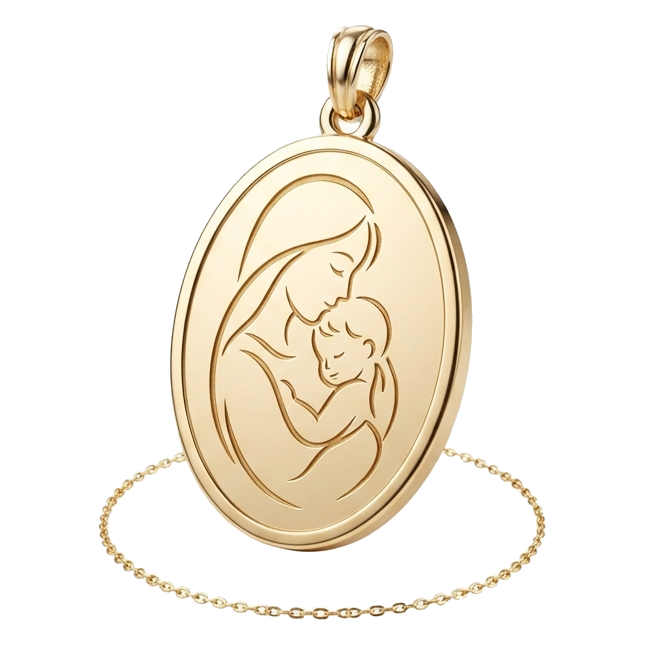
When no patron saint directly matches the first name, other religious figures serve the same gifting intention. Virgin Mary medals suit a universal maternal protection, with no link to a specific first name. Child Christ medals are chosen to directly mark the religious meaning of baptism. Guardian angel medals avoid any reference to a particular saint while keeping the protective dimension sought for a newborn. For a choice guided by symbolism rather than by the figure itself, the patron saint medals selection brings together all engravings classified by patronage: travel, health, family, or protection.
One design comes up often in requests centered on a specific first name: the Saint Anthony of Padua medal, associated with finding lost objects and difficult causes, a patronage that explains its enduring popularity across generations.
Engraving and personalization
A baptism medal is engraved on the back, generally with just a few characters: a short first name fits easily, while a compound first name or a full date requires a smaller font that stays legible on a 16 to 18 mm diameter. On a 14 mm size, the available space is most often limited to a single first name or initials. The date chosen varies by family, corresponding to either the birth or the baptism itself; both practices coexist with no strict rule. This engraving turns a standard religious medal into a one-of-a-kind piece, worn for decades afterward without losing its connection to the original event.
Who to give a patron saint medal to
The godfather or godmother remains the most common giver of this type of jewelry, presented at the baptism itself. Grandparents often choose the same engraving on the occasion of a birth, even before the religious ceremony. For a communion or a profession of faith, the choice more naturally leans toward a saint linked to the child’s own journey rather than a generic figure: a compound first name built around Michael, Thérèse, or Christopher will easily guide the decision. In every case, the chosen engraving carries a precise meaning, from the saint’s patronage to the diameter suited to the recipient’s age, which sets this type of gift apart from a piece chosen at random.
How do I choose the right patron saint medal for a baptism?
Most families pick the saint the child is named after, the saint of their birth date, or a family devotion. If none applies, Guardian Angel, Saint Christopher and Miraculous Medal designs suit any baby. When choosing a patron saint baptism medal, check that the reverse has a flat area wide enough for engraving the name and christening date.
What size medal is appropriate for a newborn?
For a newborn, a 14 to 16 mm medal is the usual choice: light enough to wear against the skin and easy to keep under clothing. From ages 5 to 10, 18 mm reads better on the chest without looking heavy. Godparents buying a christening medal for a baby boy or girl often size up and pair it with a chain the child grows into.
Gold, silver or gold-plated — what lasts best on daily wear?
Solid 9K or 18K gold keeps its colour indefinitely and suits sensitive skin. Sterling silver is far cheaper but tarnishes and needs polishing every few months. Gold-plated brass looks identical at first, though the layer wears thin after two or three years of constant contact. For a gold baptism medal for babies kept as an heirloom, solid metal is the safer purchase.
How should the medal be cleaned and stored between wears?
Wipe it with a soft dry cloth after wearing to remove skin oils, and remove it before baths, swimming and sunscreen application. Clean gold with lukewarm soapy water and a soft brush; use a silver polishing cloth on sterling, never abrasive paste on engraved sides. Storing the baptism medal in an anti-tarnish pouch keeps chlorine and humidity from dulling the finish.