Christening Cup
Showing all 8 results
-

Beaded christening baby cup
-

Biarritz christening baby cup
-

Crossed ribbons christening baby cup
-

Flared France christening baby cup
-

Flared line christening baby cup
-

Godron christening baby cup
-

Menton christening baby cup
-

Tambourin baby cup christening
Choosing between solid silver and silver-plated metal for a christening cup
The christening cup comes in two distinct material families, and the difference isn’t just felt in the weight in your hand. Solid silver carries a fineness mark, most often 925/1000, stamped under the base of the piece: this means that 925 grams out of 1000 are pure silver, with the remainder being a copper alloy that gives it structural strength. Silver-plated metal, on the other hand, is a common base metal — usually brass or nickel silver — coated with a thin layer of silver applied through electrolysis. This distinction matters for three practical reasons: price, upkeep, and how well the piece stands the test of time.
The solid 925 silver cup
A solid silver cup generally weighs between 60 and 90 grams depending on its height, which runs around 7 to 8 cm for a classic model with a handle. This material tarnishes on contact with air (silver sulphide) but regains its shine with a dedicated polishing cloth, without ever losing material the way a gold-plated finish wears away. This is why it lasts for decades and can sometimes be found tucked away in a grandparent’s drawer, still usable for a future christening in the same family.
The silver-plated cup, an accessible alternative
Silver-plated metal offers the same visual finish when new, with lower resistance to wear: the silver layer, measured in microns, eventually thins out at friction points after several years of regular use. For a gift that will mainly stay decorative, displayed on a shelf rather than used daily as a water cup, this drawback matters little compared to the price gap with solid silver.
What engraving to choose for a christening cup
Engraving is what turns a piece of silverware into a personal gift, and it’s often the deciding factor between two otherwise identical models.
First name and date, the most common choice
A christening cup is engraved on the back or around its rim, with the child’s first name and the date of the ceremony. The available surface stays small — just a few centimetres around the rim of a standard-sized cup — which limits the engraving to one or two lines: a first name alone, or a first name followed by a date in short format (day, month, year). Longer text becomes hard to read on a curved surface this size.
Placement and readability of the engraving
Where the engraving is placed changes how the piece reads: an engraving under the base stays discreet and is only seen when the cup is turned over, while an engraving on the body of the piece shows every time it’s used. On a silver-plated model, engraving cuts into the thin silver layer and, at that exact spot, may reveal the metal underneath over time; on a solid silver model, this risk doesn’t exist since the material is uniform all the way through.
Pairing the cup with other christening silverware pieces
The cup is rarely chosen on its own. It fits into a set of christening silverware pieces designed to accompany the child from birth through their first meals.
Egg cup and napkin ring, the classic trio
The trio of cup, christening egg cup and napkin ring forms the most popular table set given as a gift: three pieces in the same material and finish, used together once the child grows and starts eating at the table. Giving all three pieces at once avoids the slight shade mismatch sometimes seen between two purchases made years apart, as solid silver develops a slightly different patina depending on how it’s used.
Cup and medal, two complementary gifts
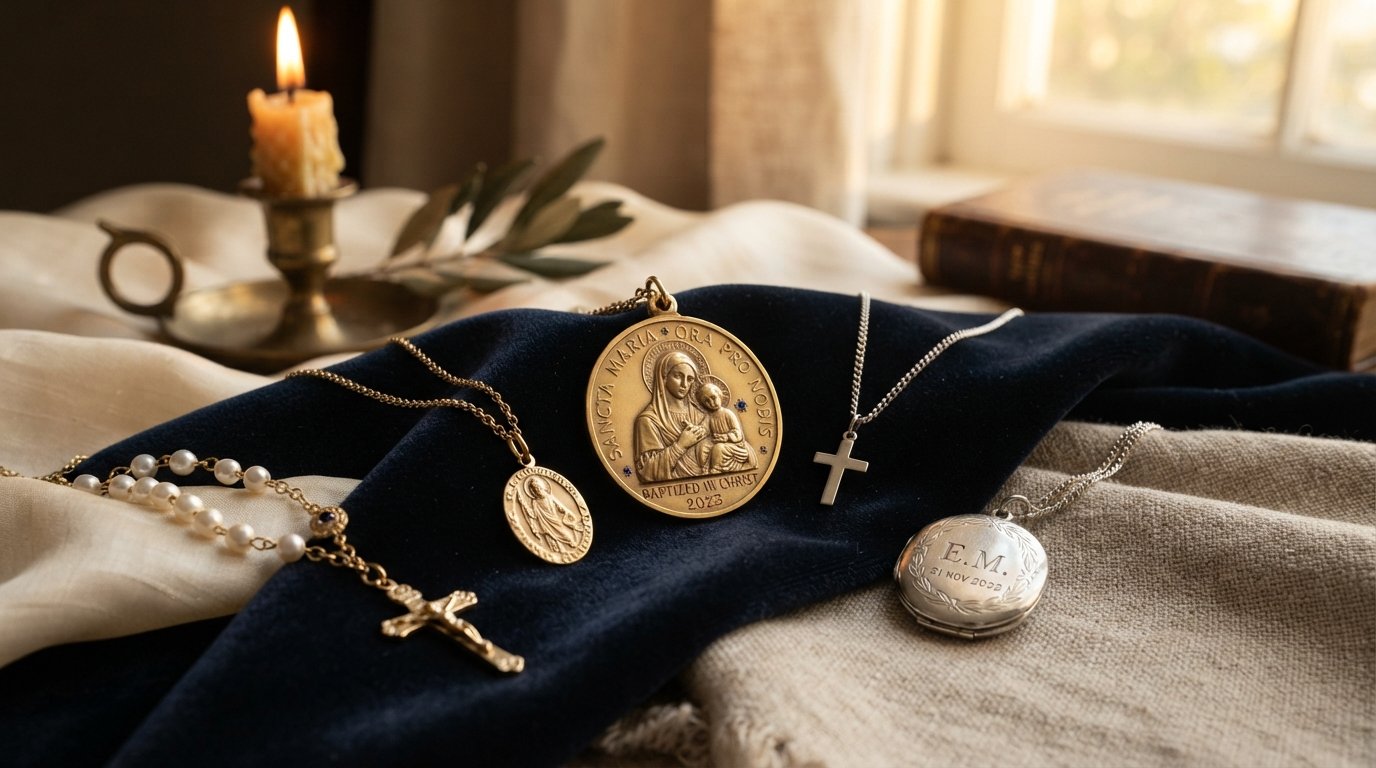
Unlike a christening medal, worn daily around the child’s neck, the cup remains a table or display piece: the two gifts don’t compete with each other and are often given by two different people at the same ceremony — a godfather for the medal, a godmother for the cup, or the other way round. For a parent looking for the complete set rather than a single piece, the christening gifts section brings these categories together, and our christening jewellery makes it easy to compare pieces meant to be worn with those meant to be kept as table pieces.
When choosing, the question to settle is simple: will the cup be used as a water cup throughout childhood, or kept as a family keepsake to be passed down later? Everyday use favours solid silver, which holds up better to repeated washing; a purely decorative use makes silver-plated metal perfectly reasonable, as long as it’s kept out of the dishwasher, which dulls the silver layer far faster than hand washing.