Christening Gifts
Showing all 25 results
-

Barrel napkin ring
-

Bead-rim barrel egg cup
-

Beaded christening baby cup
-

Biarritz christening baby cup
-

Crossed ribbons christening baby cup
-

Filet napkin ring
-

Flared France christening baby cup
-

Flared line christening baby cup
-

France egg cup
-

Gadroon egg cup
-

Godron christening baby cup
-

Hammered domed photo frame 10×15
-

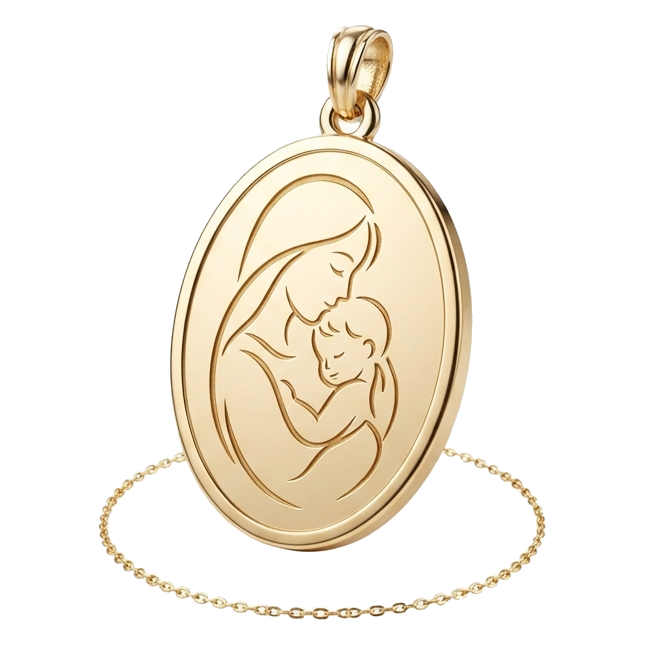
Maternity cradle medal
-

Menton christening baby cup
-

Menton egg cup
-

Multiple border photo frame 10×15
-

Napkin ring – flared gadroons
-

Pearl Egg Cup
-

Plain flared napkin ring
-

Safety pin for christening medal – 18 carats
-

Set napkin ring
-

Simple flat photo frame 10×15
-

Simple hollow photo frame 6×9
-

Tambourin baby cup christening
-

Wide flat hammered photo frame 10×15
Christening gifts: what to give depending on your place in the family
At a christening, not every relative gives the same type of gift. The godfather and godmother most often choose a christening medal and its chain, presented to the child during or just after the ceremony. Grandparents tend to lean towards a piece of solid 925 sterling silver: a christening cup, a set of cutlery or a cradle medal, items that last for decades without losing their purpose. Other guests round things out with an ID bracelet, a more discreet piece of jewellery, or an item to have engraved. These divisions remain customs rather than rules: the main thing is a gift the child will still be able to recognise twenty years later.
The christening medal: motifs, materials and sizes
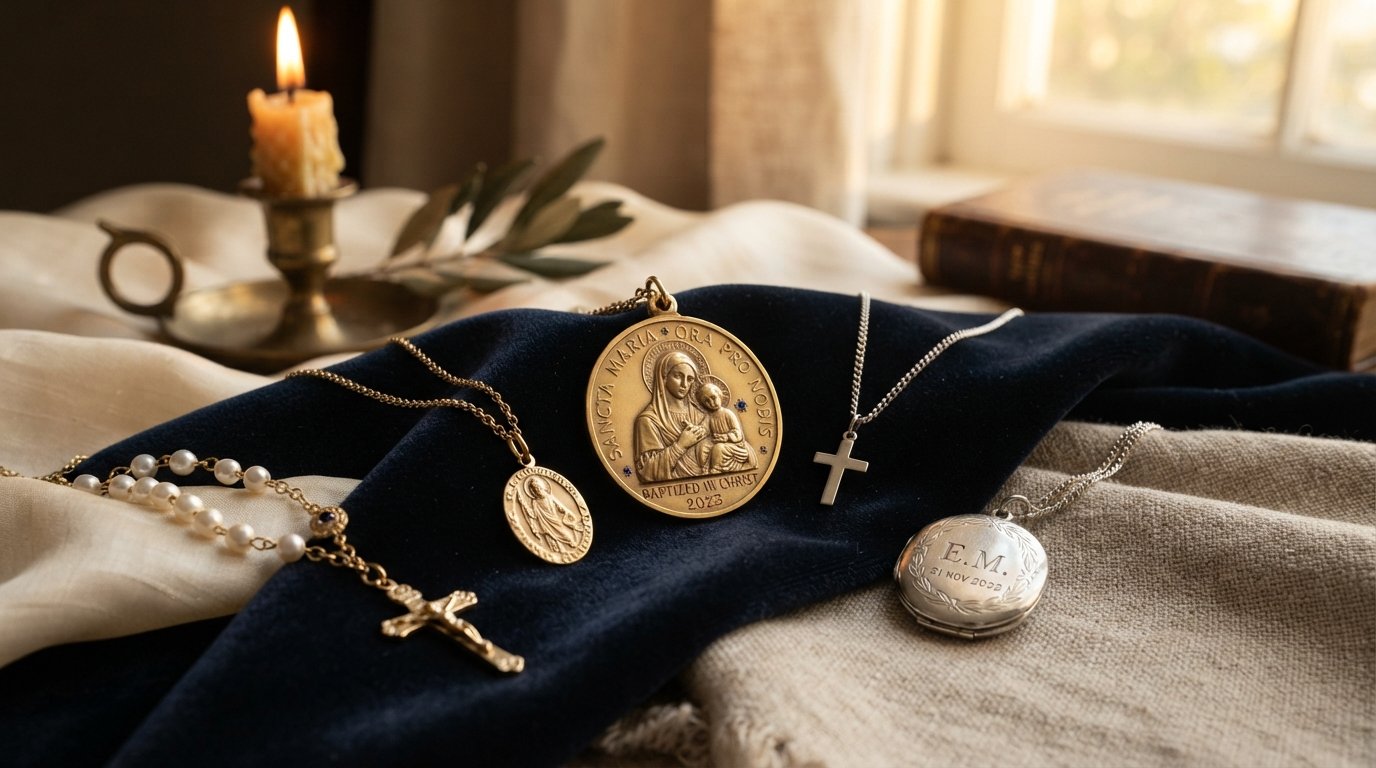
The medal remains the most popular religious jewel given for a christening. The most common motifs are the Virgin Mary, Christ, the guardian angel, the cross, the dove of the Holy Spirit and the Miraculous Medal, whose design dates back to the apparition reported by Catherine Labouré in 1830 at the Chapel of Our Lady of the Miraculous Medal, Rue du Bac in Paris. The choice is also often guided by the patron saint linked to the child’s first name: Saint Christopher, Saint Michael, Saint Joseph and Saint Theresa are among the most requested.
In terms of material, you’ll find 18-carat yellow, white or rose gold (750/1000), 9-carat gold (375/1000, more affordable), solid 925 sterling silver and vermeil. The diameter is generally chosen between 14 and 20 mm for an infant, up to 22 mm for an older child or a model worn into adulthood; weight is measured in grams and directly affects the price outside of promotions. The chain, in curb, box or figaro links, is usually chosen between 40 and 45 cm for a child, a length that can later be adjusted as they grow.
Choosing the motif based on the first name or patron saint
For a girl, families often turn to a medal of the Virgin Mary or an oval shape, sometimes in mother-of-pearl. For a boy, Christ, the guardian angel or the cross remain safe choices. Beyond these customs, choosing the patron saint of the first name gives a motif with real meaning rather than a default choice. Right from birth, a cradle medal follows the same symbolic logic, in a smaller format.
Engraving, a common practice on the back of the medal
The back of a christening medal is traditionally engraved with the child’s first name and the date of the ceremony, sometimes the date of birth. The available surface remains limited on a diameter of 14 to 18 mm: a few characters fit, but a long text won’t remain legible. On a larger model, from 20 mm upwards, a second line becomes possible.
Christening silverware: cup, egg cup and napkin ring
Silverware pieces form the other major pillar of christening gifts, in solid silver or silver-plated metal depending on budget. The cup remains the most popular gift, available in several traditional ranges: crossed ribbons, reeded, beaded, gadrooned or flared models. The napkin ring and egg cup often accompany the cup as part of a matching set, while cutlery completes the ensemble for everyday table use rather than purely decorative purposes. These items, engraved with a first name and a date, stand apart from jewellery through their practical, everyday use.
Photo frames, keepsakes to personalise
A photo frame in silver or silver-plated metal suits any age, from infancy through to the teenage years, when a cup is no longer of much use but a keepsake can still be displayed in a bedroom. Like silverware pieces, it can be engraved on the back or around the edge with a date or first name, and should be chosen based on what the recipient will actually use rather than out of convention.
After the christening: communion, confirmation, profession of faith
Christening opens up a series of milestones in a child’s Christian life, each with its own gift-giving customs. Communion often follows the same principle as the medal or rosary, while confirmation tends towards more understated jewellery, worn at an age when the child has more say in the choice themselves. Keeping these milestones in mind helps you scale gifts appropriately rather than repeating the same present at every ceremony.
Frequently asked questions about choosing a christening gift
Who gives the medal, who gives the silverware?
The godfather and godmother traditionally give the medal and its chain. Grandparents tend to favour a piece of solid silver such as a cup or cutlery. Other relatives opt for an ID bracelet or an item to be engraved, with no strict rule beyond these customs.
What size medal for an infant?
A diameter of 14 to 16 mm suits an infant, with a chain of 40 to 45 cm. After a few years, an 18 to 20 mm model remains more legible and easier to wear day to day.
Gold or silver: how to decide?
Solid 925 silver and 9-carat gold (375/1000) remain the most affordable options; 18-carat gold (750/1000) costs more but withstands wear better over several decades. The choice mainly depends on intended use: a piece of jewellery worn every day justifies a higher purity.
How do you care for a silver christening jewel?
A soft, dry cloth after each wear is enough to limit tarnishing. Avoid prolonged contact with water, perfume or creams, and store the jewel in a closed pouch between uses. An anti-tarnish cloth restores shine to silver that has darkened.
How do I choose the right christening medal size for a baby?
Most baptism medals for babies measure 14 to 16 mm in diameter, light enough for a newborn’s chest and easy to hide under a gown. An 18 to 20 mm medal suits a christening kept as a keepsake or worn later, around age seven to twelve. Pair a 14 mm medal with a 36 to 40 cm chain.
What is the difference between gold, gold-filled and sterling silver medals?
Solid 9ct or 18ct gold keeps its colour permanently and suits daily wear on sensitive skin. Gold-filled has a bonded gold layer several microns thick, lasting years at roughly a third of the price. Sterling silver christening jewellery is the most affordable but tarnishes and needs polishing every few months.
Can a christening medal be engraved with a name and date?
Yes, the reverse side is usually left plain for engraving. Count on 15 to 20 characters for a first name and baptism date, laser-engraved in about three to five working days. Deeper hand engraving needs a medal of at least 16 mm. Order a personalised engraved baptism medal before adding the chain, as engraving is done on the pendant alone.
How should I clean and store a baptism medal?
Wipe gold with a soft cloth and warm soapy water, then dry fully before storing. Silver needs a treated polishing cloth; avoid dips on enamelled or oxidised details, which they strip. Store the medal in an airtight pouch to slow tarnishing, and remove it before swimming, since chlorine attacks solder points on the bail and chain.