Cradle Medal
Showing the single result

What is a cradle medal
The cradle medal isn’t worn. It hangs from the rail of a spindle bed or above a bassinet, at the child’s eye level rather than an adult’s. This difference in use changes everything about the choice: unlike a christening medal meant to be worn on a chain from the first months, the cradle medal can take on a more generous diameter, often between 25 and 35 mm, since it never comes into contact with the baby’s skin.
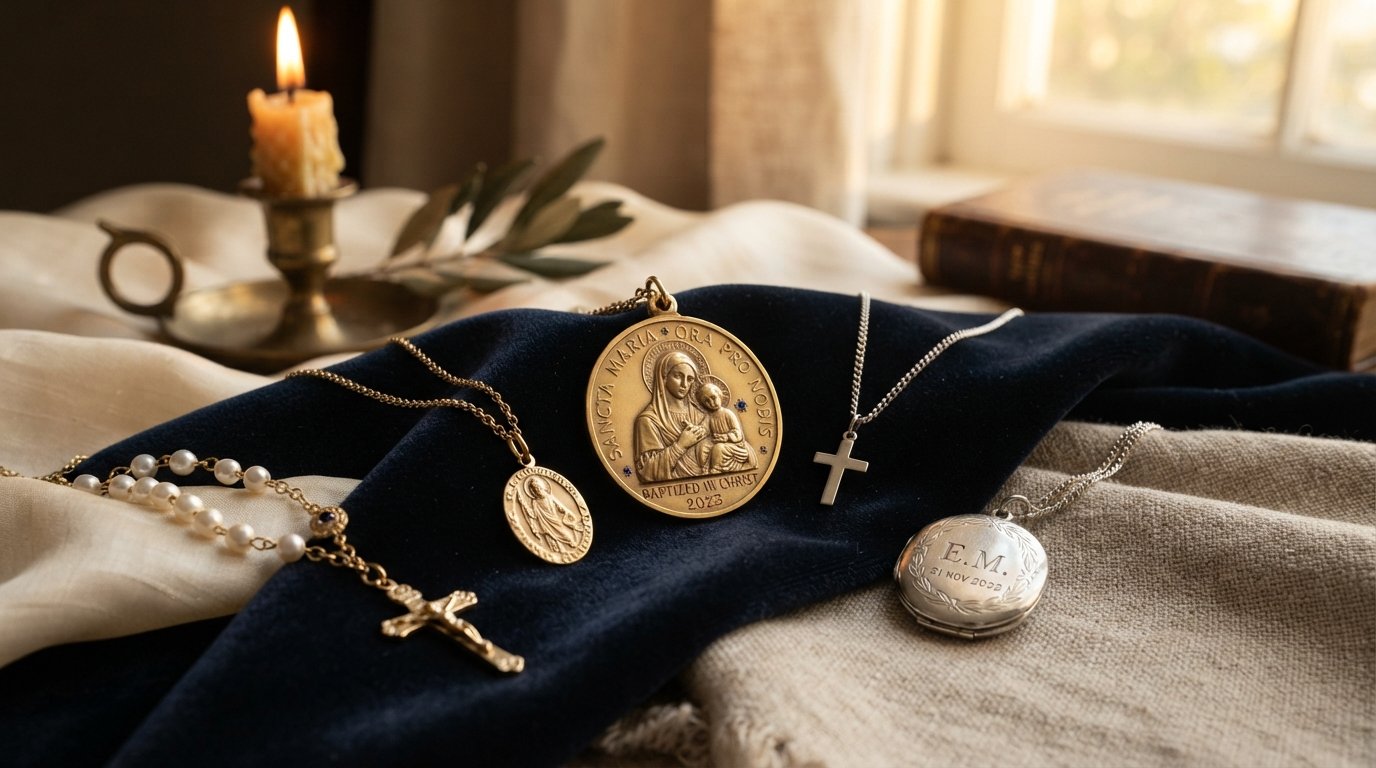
The piece remains a classic of French religious silverware, given at birth or christening, most often by the grandparents. It stays in the child’s room for years, long after the ceremony has passed, which calls for more detailed engraving and stamping work than a medal meant to disappear under a shirt collar.
A category apart within christening silverware
It’s sometimes mistaken for a medal bracelet or an ID bracelet, but the cradle medal belongs to a different family: birth gifts meant for display rather than for wear. It’s chosen with a matching ribbon or cord, never with a neck chain.
Choosing the effigy based on the first name or family devotion
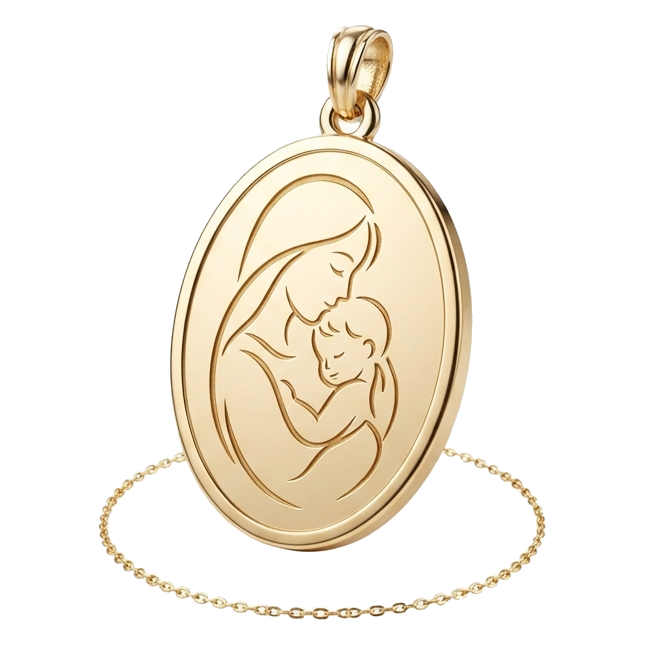
Three types of effigies dominate this kind of medal. Our Lady of the Child remains the most requested for a birth: it represents motherhood and is often chosen to echo the mother’s or grandmother’s first name. Next comes the guardian angel, shown alone or watching over a sleeping child, an image directly tied to the medal’s protective purpose. Patron saints round out the choice when the child’s first name calls for a specific figure: Saint Thérèse of the Child Jesus, Saint Joseph, or, more rarely, a local saint tied to family devotion.
The Miraculous Medal, a dated reference point
Among Marian effigies, the Miraculous Medal has a precise origin: its design dates back to the apparition reported by Catherine Labouré in 1830, on Rue du Bac in Paris. This historical marker explains why its design, the Virgin standing on the globe with open hands, has remained unchanged for nearly two centuries across most reproductions. It’s a safe choice when the family wants an unmistakably recognizable Marian effigy.
Angels and protective figures
For families who prefer imagery less tied to a specific devotion, angel medals and Our Lady of the Child medals offer a gentler theme, focused on protecting the child rather than a Marian devotional episode.
Material, dimensions and engraving
Sterling silver dominates this segment of silverware, almost always at 925 fineness, a guarantee of durability for an item meant to stay in place for years with no special upkeep. Weight varies with diameter and strike thickness: a 30 mm sterling silver medal generally weighs between 8 and 15 grams, noticeably more than a christening medal worn on a chain, whose weight is kept low for comfort.
A diameter designed for hanging, not for the neck
The diameter is chosen mainly based on where the piece will be hung: a spindle bed rail easily supports a 30 to 35 mm medal, while a tighter space, such as a bassinet’s hood frame, calls for a smaller 20 to 25 mm model. This freedom of size is exactly what sets the cradle medal apart from worn silver jewelry, which is constrained by the child’s build.
Engraving the back, a common practice
The back of a cradle medal is traditionally engraved with the first name and the date of birth or christening. The surface available on a 25 to 30 mm diameter generally allows for two readable lines of text, compared with a short single line on smaller formats. It’s this inscription that turns the piece into a dated keepsake, rediscovered years later in a box of memories, long after the medal has left the cradle.