New arrivals
18-carat yellow gold christening medal: which effigy to choose
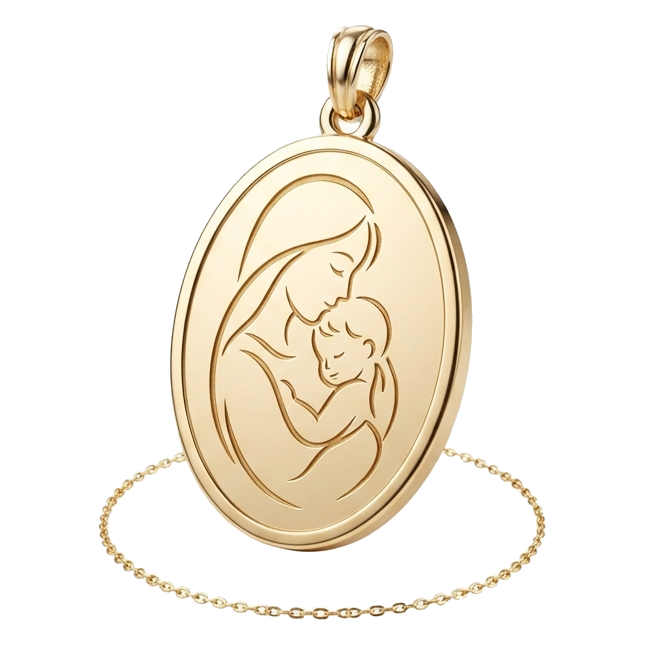
A christening medal is chosen first for its effigy, before the material or the diameter. The Virgin and Child remains the most requested design for a christening, whether for a girl or a boy: it conveys the idea of maternal protection, with no gender connotation. The Christ or Sacred Heart suits a family wanting to mark the religious significance of the gesture rather than the Marian symbol. The Miraculous Medal dates back to a documented apparition: Catherine Labouré is said to have received it in 1830 on Rue du Bac in Paris, and this design has remained popular for nearly two centuries without changing shape. For a specific first name, the corresponding patron saint gives the gift extra meaning: Saint Christopher protects travelers, Saint Michael evokes strong protection, and Saint Theresa suits a little girl. The angel, the dove or the chrism suit families who prefer a more discreet symbol than a face.
Choosing the diameter according to the child’s age
A christening medal should be chosen by actual diameter, not by guesswork. For a newborn, a diameter of 14 to 16 mm is the most popular: light enough not to be a bother, while still leaving enough room on the back for a legible engraving. From 18 mm upward, the medal gains more presence and suits an older child or a gift meant to last several years. The 20 and 22 mm diameters are mostly found on pieces worn by an adult, godmother or godfather, who wants a medal matching the child’s own.
Engraving on the back: what to know before ordering
A christening medal is engraved on the back, usually with the child’s first name and the christening date. The available space depends directly on the diameter: on a 14 mm medal, two short lines are enough to fill the whole legible area, whereas a piece of 20 mm or more leaves room for a full date or a short phrase. It’s best to choose the diameter before deciding on the text to engrave, not the other way around.
18-carat yellow gold: what this hallmark actually means
18-carat yellow gold corresponds to a fineness of 750/1000: 750 grams of pure gold per 1000 grams of alloy. This is the benchmark fineness for a christening jewel meant to last through the years without losing its shine, unlike 9-carat gold (375/1000), which is more affordable but also paler and more prone to scratching. An 18-carat medal is also chosen for how well it holds up over time: a piece worn daily by a child, and later by the adult they become, takes far more wear than a ceremonial jewel worn once a year. Finishes vary depending on the look desired: a polished finish gives a bright shine, a matte sandblasted finish softens reflections and better hides everyday micro-scratches, while a hammered finish plays on texture rather than shine.
Matching chain: length and link style for a child’s jewelry
A medal is rarely worn alone: it hangs from a yellow gold chain, available in a curb link or a diamond-cut or round link. The curb chain, with its flattened links, holds up better to twisting and suits an active child; the round link chain, with its classic rounded links, sits more discreetly under a collar. For a child, the ideal length is between 40 and 45 cm: any shorter and the chain quickly becomes too tight as the child grows, any longer and the clasp falls onto the breastbone and gets in the way. It’s better to choose a slightly generous length than to have to replace the chain the following year.
Completing the christening gift
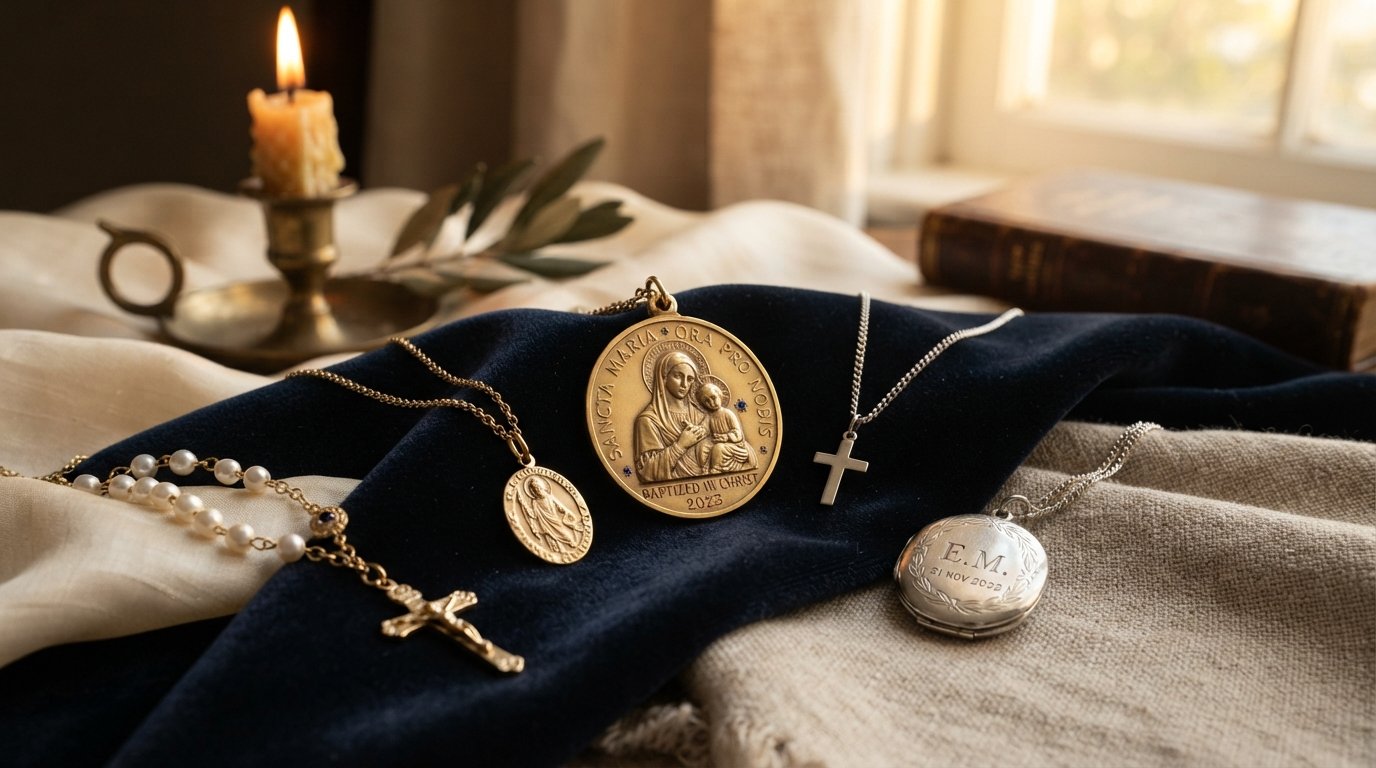
The medal is often just the first piece of a larger gift. A christening cross is chosen following the same logic of diameter and engraving. For a younger child, a baby bracelet engraved with the first name often complements the piece worn around the neck. Families who prefer a gift to display rather than to wear turn to table silverware: an engraved cup, napkin ring or egg cup, or a photo frame to mark the christening date. For an older girl, christening earrings in yellow gold sometimes complete the set, matching the medal’s hallmark to keep the whole gift consistent in material.
For a child’s first piece of jewelry, it’s best to start with the first name and the effigy that suits it, then choose the diameter based on age, and finally the chain based on the child’s build. Following this order avoids unpleasant surprises with the engraving, often the detail that truly makes or breaks a christening gift.
18-carat yellow gold christening medal: which effigy to choose
A christening medal is chosen first for its effigy, before the material or the diameter. The Virgin and Child remains the most requested design for a christening, whether for a girl or a boy: it conveys the idea of maternal protection, with no gender connotation. The Christ or Sacred Heart suits a family wanting to mark the religious significance of the gesture rather than the Marian symbol. The Miraculous Medal dates back to a documented apparition: Catherine Labouré is said to have received it in 1830 on Rue du Bac in Paris, and this design has remained popular for nearly two centuries without changing shape. For a specific first name, the corresponding patron saint gives the gift extra meaning: Saint Christopher protects travelers, Saint Michael evokes strong protection, and Saint Theresa suits a little girl. The angel, the dove or the chrism suit families who prefer a more discreet symbol than a face.
Choosing the diameter according to the child's age
A christening medal should be chosen by actual diameter, not by guesswork. For a newborn, a diameter of 14 to 16 mm is the most popular: light enough not to be a bother, while still leaving enough room on the back for a legible engraving. From 18 mm upward, the medal gains more presence and suits an older child or a gift meant to last several years. The 20 and 22 mm diameters are mostly found on pieces worn by an adult, godmother or godfather, who wants a medal matching the child's own.
Engraving on the back: what to know before ordering
A christening medal is engraved on the back, usually with the child's first name and the christening date. The available space depends directly on the diameter: on a 14 mm medal, two short lines are enough to fill the whole legible area, whereas a piece of 20 mm or more leaves room for a full date or a short phrase. It's best to choose the diameter before deciding on the text to engrave, not the other way around.
18-carat yellow gold: what this hallmark actually means
18-carat yellow gold corresponds to a fineness of 750/1000: 750 grams of pure gold per 1000 grams of alloy. This is the benchmark fineness for a christening jewel meant to last through the years without losing its shine, unlike 9-carat gold (375/1000), which is more affordable but also paler and more prone to scratching. An 18-carat medal is also chosen for how well it holds up over time: a piece worn daily by a child, and later by the adult they become, takes far more wear than a ceremonial jewel worn once a year. Finishes vary depending on the look desired: a polished finish gives a bright shine, a matte sandblasted finish softens reflections and better hides everyday micro-scratches, while a hammered finish plays on texture rather than shine.
Matching chain: length and link style for a child's jewelry
A medal is rarely worn alone: it hangs from a yellow gold chain, available in a curb link or a diamond-cut or round link. The curb chain, with its flattened links, holds up better to twisting and suits an active child; the round link chain, with its classic rounded links, sits more discreetly under a collar. For a child, the ideal length is between 40 and 45 cm: any shorter and the chain quickly becomes too tight as the child grows, any longer and the clasp falls onto the breastbone and gets in the way. It's better to choose a slightly generous length than to have to replace the chain the following year.
Completing the christening gift
The medal is often just the first piece of a larger gift. A christening cross is chosen following the same logic of diameter and engraving. For a younger child, a baby bracelet engraved with the first name often complements the piece worn around the neck. Families who prefer a gift to display rather than to wear turn to table silverware: an engraved cup, napkin ring or egg cup, or a photo frame to mark the christening date. For an older girl, christening earrings in yellow gold sometimes complete the set, matching the medal's hallmark to keep the whole gift consistent in material.
For a child's first piece of jewelry, it's best to start with the first name and the effigy that suits it, then choose the diameter based on age, and finally the chain based on the child's build. Following this order avoids unpleasant surprises with the engraving, often the detail that truly makes or breaks a christening gift.
18-carat yellow gold christening medal: which effigy to choose
A christening medal is chosen first for its effigy, before the material or the diameter. The Virgin and Child remains the most requested design for a christening, whether for a girl or a boy: it conveys the idea of maternal protection, with no gender connotation. The Christ or Sacred Heart suits a family wanting to mark the religious significance of the gesture rather than the Marian symbol. The Miraculous Medal dates back to a documented apparition: Catherine Labouré is said to have received it in 1830 on Rue du Bac in Paris, and this design has remained popular for nearly two centuries without changing shape. For a specific first name, the corresponding patron saint gives the gift extra meaning: Saint Christopher protects travelers, Saint Michael evokes strong protection, and Saint Theresa suits a little girl. The angel, the dove or the chrism suit families who prefer a more discreet symbol than a face.
Choosing the diameter according to the child’s age
A christening medal should be chosen by actual diameter, not by guesswork. For a newborn, a diameter of 14 to 16 mm is the most popular: light enough not to be a bother, while still leaving enough room on the back for a legible engraving. From 18 mm upward, the medal gains more presence and suits an older child or a gift meant to last several years. The 20 and 22 mm diameters are mostly found on pieces worn by an adult, godmother or godfather, who wants a medal matching the child’s own.
Engraving on the back: what to know before ordering
A christening medal is engraved on the back, usually with the child’s first name and the christening date. The available space depends directly on the diameter: on a 14 mm medal, two short lines are enough to fill the whole legible area, whereas a piece of 20 mm or more leaves room for a full date or a short phrase. It’s best to choose the diameter before deciding on the text to engrave, not the other way around.
18-carat yellow gold: what this hallmark actually means
18-carat yellow gold corresponds to a fineness of 750/1000: 750 grams of pure gold per 1000 grams of alloy. This is the benchmark fineness for a christening jewel meant to last through the years without losing its shine, unlike 9-carat gold (375/1000), which is more affordable but also paler and more prone to scratching. An 18-carat medal is also chosen for how well it holds up over time: a piece worn daily by a child, and later by the adult they become, takes far more wear than a ceremonial jewel worn once a year. Finishes vary depending on the look desired: a polished finish gives a bright shine, a matte sandblasted finish softens reflections and better hides everyday micro-scratches, while a hammered finish plays on texture rather than shine.
Matching chain: length and link style for a child’s jewelry
A medal is rarely worn alone: it hangs from a yellow gold chain, available in a curb link or a diamond-cut or round link. The curb chain, with its flattened links, holds up better to twisting and suits an active child; the round link chain, with its classic rounded links, sits more discreetly under a collar. For a child, the ideal length is between 40 and 45 cm: any shorter and the chain quickly becomes too tight as the child grows, any longer and the clasp falls onto the breastbone and gets in the way. It’s better to choose a slightly generous length than to have to replace the chain the following year.
Completing the christening gift
The medal is often just the first piece of a larger gift. A christening cross is chosen following the same logic of diameter and engraving. For a younger child, a baby bracelet engraved with the first name often complements the piece worn around the neck. Families who prefer a gift to display rather than to wear turn to table silverware: an engraved cup, napkin ring or egg cup, or a photo frame to mark the christening date. For an older girl, christening earrings in yellow gold sometimes complete the set, matching the medal’s hallmark to keep the whole gift consistent in material.
For a child’s first piece of jewelry, it’s best to start with the first name and the effigy that suits it, then choose the diameter based on age, and finally the chain based on the child’s build. Following this order avoids unpleasant surprises with the engraving, often the detail that truly makes or breaks a christening gift.
